

Blog
PreStocks vs Paimon Finance: Onchain Pre-IPO Markets Compared
A data-driven look at how PreStocks and Paimon are building onchain access to private companies and where their models differ.
Contributors
Modestus Okoye, zayd.web3
2026 is a breakout year for onchain pre-IPO trading.
First, SpaceX recorded $319M in cumulative trading volume ahead of its Nasdaq listing, while CXMT’s pre-IPO perpetuals generated $178M before its Shanghai debut.
With activity like this, the question is shifting from “Is there demand for pre-IPO exposure onchain?” to “where can we access it?”
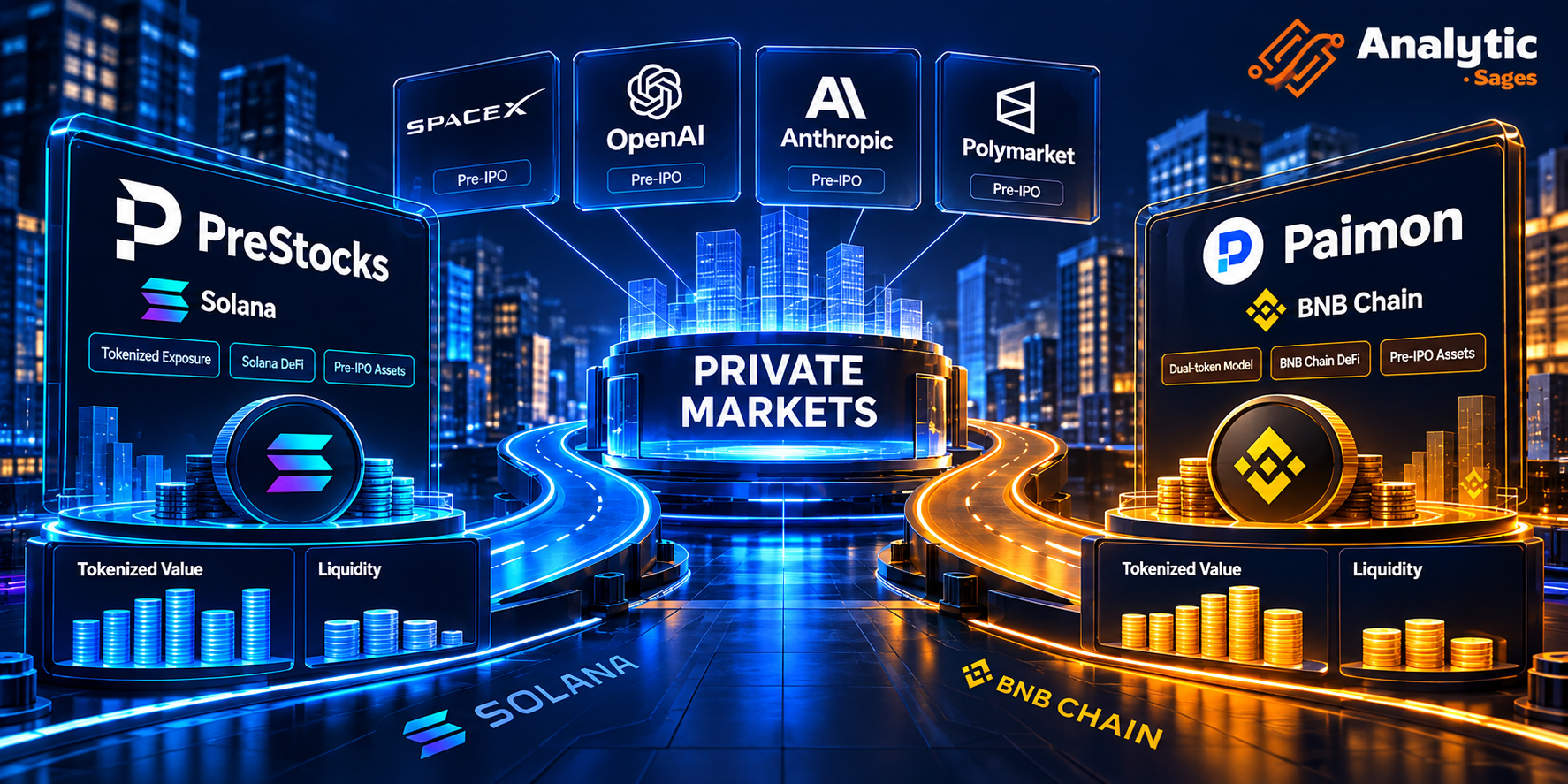
Two platforms on our radar are PreStocks, a Solana-based marketplace for private-company exposure, and Paimon Finance, a private-markets platform on BNB Chain.
In this article, we explore how they work, what their onchain data reveals, and where both could go from here.
PreStocks: Solana’s Gateway to Pre-IPO Giants
Formerly known as prePO, Prestocks offers tokenized exposure to private companies.
Its roots date back to 2021 when they launched as a decentralized private-markets protocol on Arbitrum. The idea was simple: let traders bet on what companies and crypto projects could be worth before they became publicly tradable.
With time, that idea evolved into PreStocks, shifting from speculation on valuations to tokens linked to private-company exposure. By August 2025, the platform had moved to Solana, bringing names like OpenAI, Anthropic, and Anduril into its DeFi markets.
Since then, PreStocks has attracted considerable trading activity, with its platform reporting the following cumulative figures:
- $1.807 billion in trading volume
- 17.54 million transactions
- 113K+ holders
How Prestock works
PreStocks is built on Special Purpose Vehicles (SPVs).
These are holding entities that provide direct or indirect exposure to shares of private companies. PreStocks uses that exposure to back tokens issued on Solana, allowing users to trade the economic value of those companies without directly owning their shares or receiving the same shareholder rights. Once issued, the tokens trade through Solana DeFi markets such as Jupiter, Meteora, and Raydium.
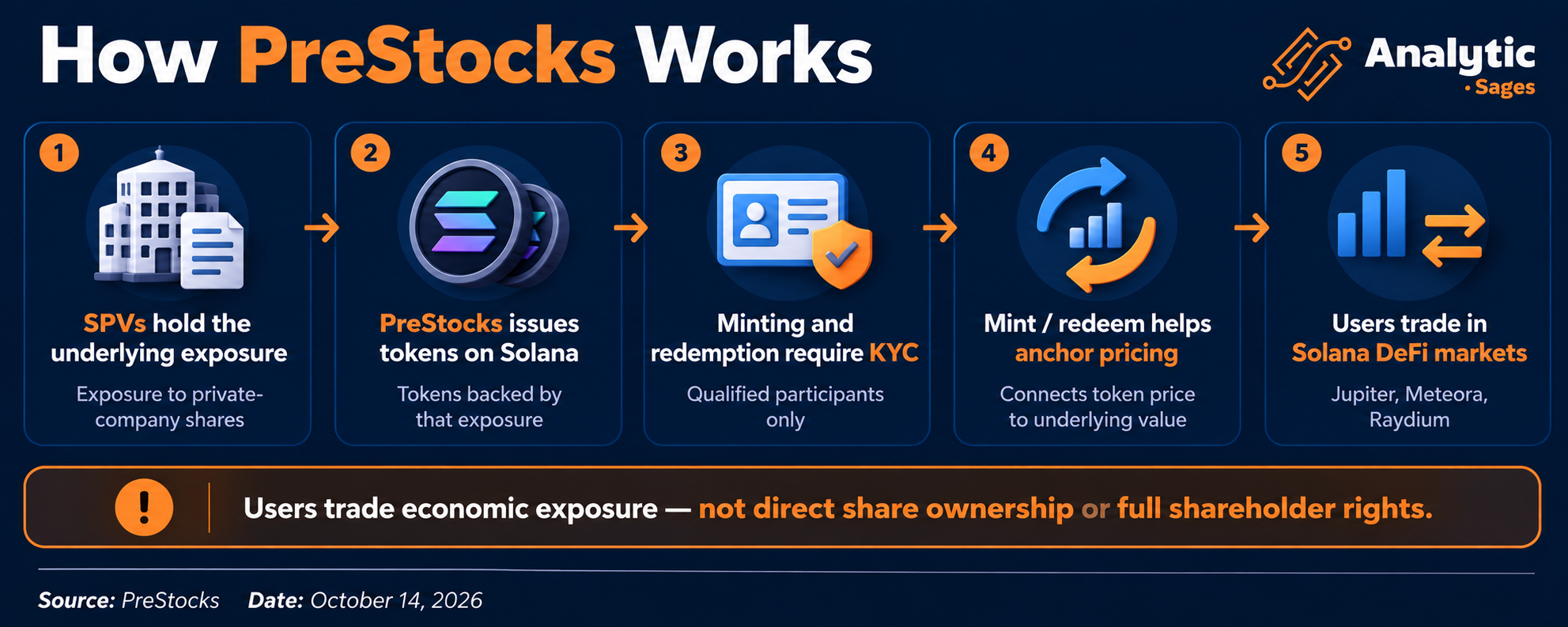
According to PreStocks, users can trade them without KYC, but qualified participants involved in minting and redemption must undergo identity verification.
This is important because minting and redemption help connect the token's market price to the value of the underlying private-company exposure.
For instance, if a token trades significantly above its reference value, qualified participants may mint more tokens to sell at the higher price. When it trades below that value, they may buy and redeem tokens instead. This arbitrage can help close the price gap, although redemption restrictions, fees, and liquidity can limit the process.
To make these differences visible, PreStocks publishes a mark price for each asset. This represents the platform's reference valuation for the underlying exposure, while the actual DEX price depends on supply, demand, and available liquidity.
Costs also go beyond normal DEX trading fees. At the time of our research, seven of the nine listed assets carried a 3% transfer fee, which the platform describes as being distributed to holders of the relevant token.
But what happens when the private company eventually goes public or gets acquired?
PreStocks has a conversion framework for these situations. Following an IPO, holders may convert their tokens into equivalent tokenized public-stock instruments within a window of up to nine months, including an initial lockup period. Mergers and acquisitions follow different arrangements depending on whether the transaction involves cash or shares, with a stated conversion window of six months where applicable.
Holders must complete any required conversion before the deadline, or their old tokens can expire worthless.
SpaceX is a current example. PreStocks has announced that holders of its original SPACEX token must swap into SPCXx before March 12, 2027, at 11:59 p.m. UTC, or risk losing the value of their old tokens.
Onchain Drivers
PreStocks has grown considerably since its Solana launch.
In its first week, the platform generated about $3.3 million in trading volume, but by March 2026, cumulative volume had reached $544.78 million, before climbing to $1.81 billion by September 29.
That's a 3.32x increase in roughly six months.
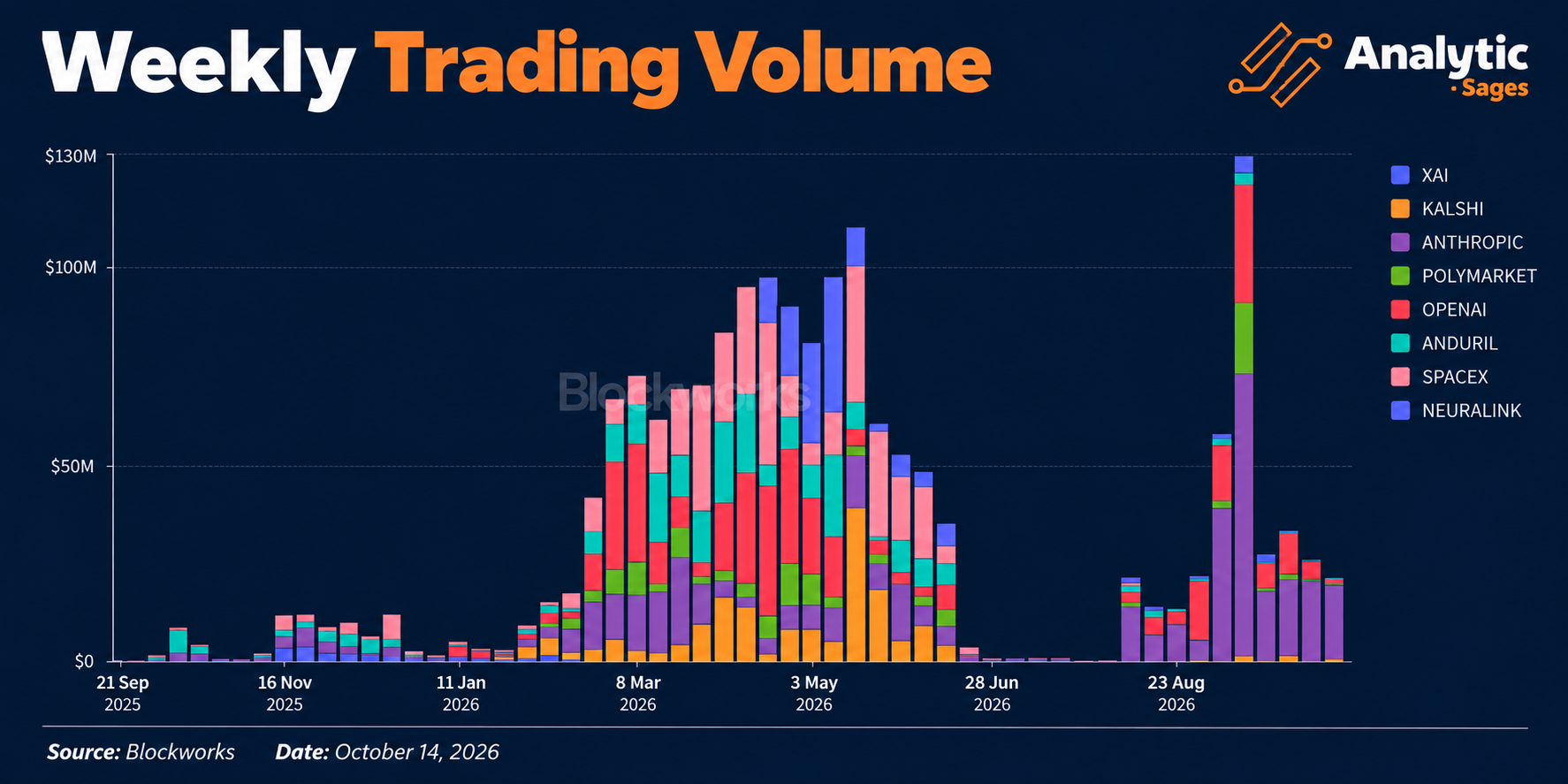
Growth has also been reflected in the value of assets represented onchain. From September 2025 to May 2026, tokenized market cap rose from just over $2 million to a peak above $26 million.
However, that growth hasn't been without setbacks.
In May, OpenAI and Anthropic issued warnings about unauthorized transactions involving their private shares, including exposure created through SPVs. Both companies warned that such transactions could be invalid or unrecognized, triggering sharp declines in the prices of their corresponding PreStocks tokens.
Despite the disruption, the platform's tokenized market cap had recovered to approximately $21.67 million by September 29.
But while trading activity and tokenized value have grown, the amount of capital actually being used across DeFi tells a different story.
At the September snapshot, PreStocks had about $530k in active DeFi TVL, representing just 3.2% of its $21.67 million tokenized market cap.
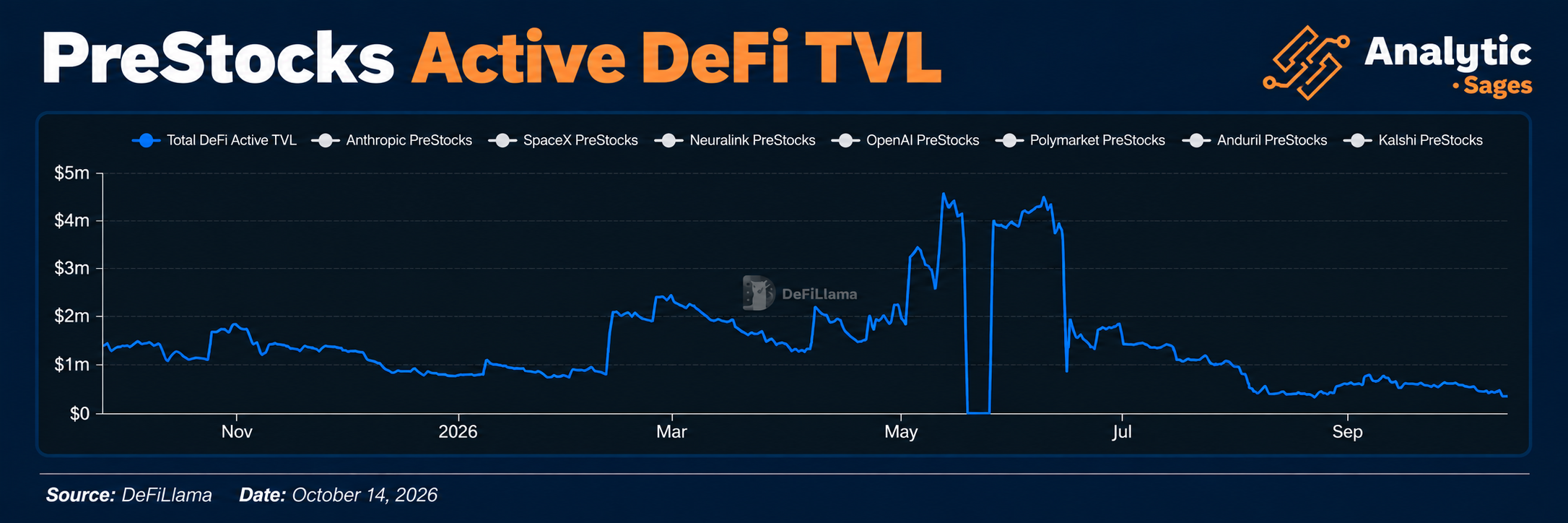
Liquidity was also relatively thin. The main trading pools across its nine assets held only about $820,000 in combined liquidity, despite the platform recording roughly $5.15 million in 24-hour trading volume across all pools.
In other words, PreStocks has been more successful at making private-company exposure tradable than at getting those assets used more deeply across DeFi.
Fees present another interesting picture.
According to DefiLlama, PreStocks had generated approximately $265.3K in cumulative fees, with May 2026 accounting for roughly 40% of that amount. However, the platform's tracked fee data stopped updating in early June.
That makes it difficult to determine how much additional fee income the platform generated during the subsequent growth in trading activity.
Asset Analysis
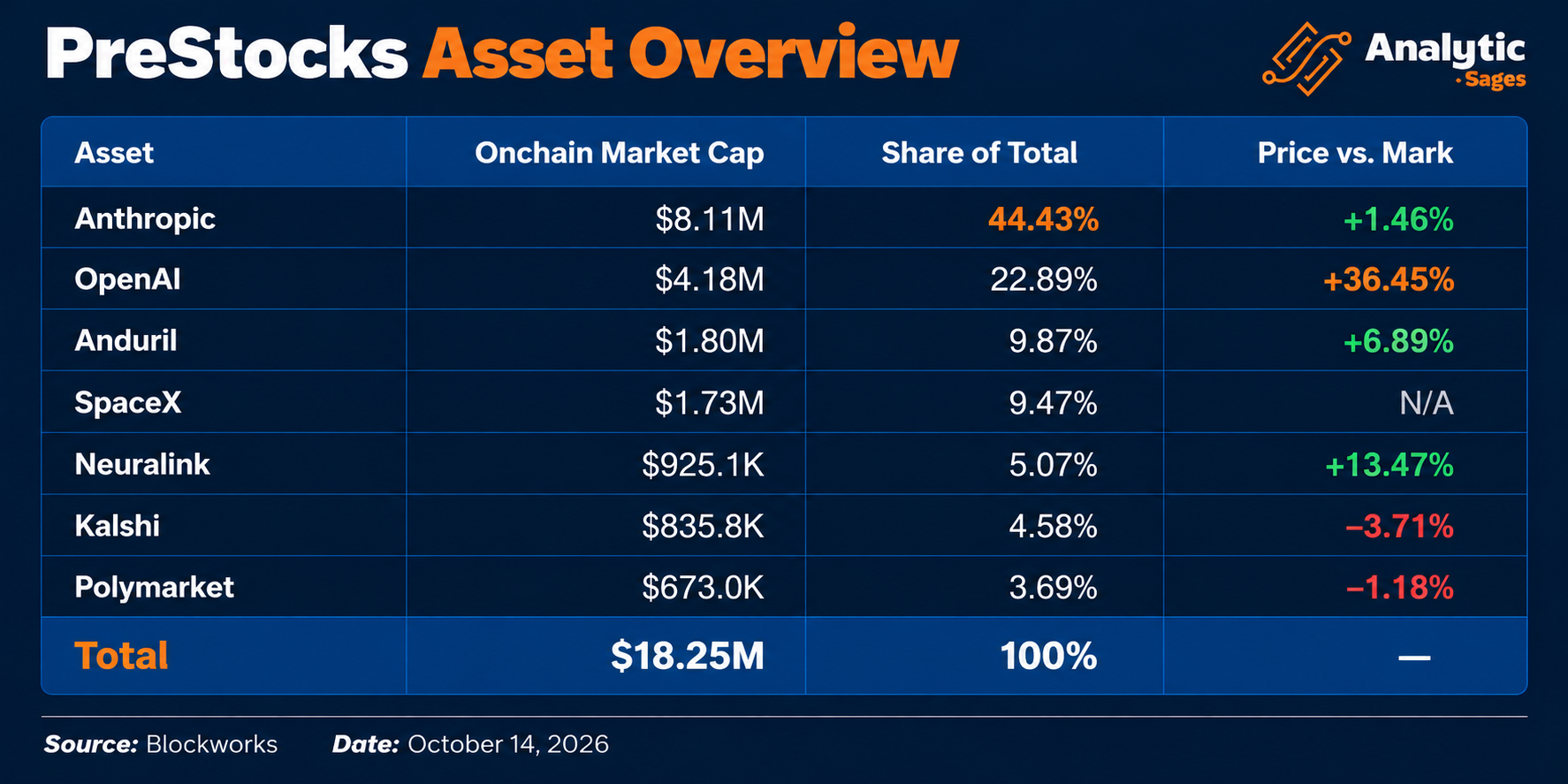
PreStocks' market remains heavily concentrated around a few companies, with Anthropic now leading in tokenized value.
It accounts for roughly 44.4% of the platform's $18.25 million in onchain assets, followed by OpenAI at 22.9% and Anduril at 9.9%.
Together, these three companies represent approximately 77.2% of PreStocks' tokenized value, showing just how concentrated the market remains. But another interesting finding is how differently these assets trade against their underlying reference valuations.
PreStocks publishes a mark price for each token, yet the actual market price can move considerably above or below it.
According to Blockworks, OpenAI trades at a 36.45% premium to its mark price, while Neuralink trades at a 13.47% premium. Meanwhile, Kalshi and Polymarket trade at discounts of 3.71% and 1.18%, respectively.
This means buyers of tokens trading at premiums are paying more than the platform's reference valuation for the underlying exposure.
That creates an additional risk because even if the mark price remains unchanged, buyers can still lose money if the premium narrows.
Paimon Finance: Bringing Private Markets and Yield Under One Roof
Founded in 2024, Paimon Finance is a BNB Chain-based RWA platform focused on bringing institutional and private-market products onchain.
Unlike PreStocks, which is largely centered around tokenized pre-IPO exposure, Paimon has branched into multiple products, including Paimon Prime, a yield product built around private-credit exposure; Pre-Access, where users can access tokenized SPV exposure to private companies; and a Tokenization-as-a-Service arm for funds, issuers, and private-asset owners looking to bring their own assets onchain.
The private-market side is the most relevant to this analysis. Paimon has built onchain exposure around companies including SpaceX, OpenAI, Kalshi and Polymarket, while its broader launchpad currently lists additional private-market deals.
From BNB Chain Incubation to YZi Labs Backing
Paimon's journey started gaining traction in 2024 when it emerged as one of the winners of the BNB Incubation Alliance at TOKEN2049 Singapore.
At the time, the project was focused on making alternative investments more accessible through AI-powered portfolios, particularly products traditionally reserved for institutional investors.
That early recognition earned Paimon a place in Season 8 of the Most Valuable Builder (MVB) accelerator, supported by BNB Chain, Binance Labs and CMC Labs.
The relationship has since developed beyond incubation. Paimon now identifies YZi Labs as a strategic backer as it expands into tokenized private-company investments and institutional yield products.
One important step into private markets came in 2025 with tokenized SpaceX exposure. Since then, Paimon has expanded its pre-IPO offering to include companies such as OpenAI, Kalshi and Polymarket.
By September 2026, four of these assets were actively trading on BNB Chain, with approximately $9.97 million in tokenized value at Paimon's mark prices and more than 8,100 summed holder positions.
However, much of its capital sat elsewhere. Paimon Prime had reached approximately $13.44 million in TVL, showing that its institutional yield business was already larger than its tradable pre-IPO market.
How Paimon’s Private-Market Rail Works
Like PreStocks, Paimon uses Special Purpose Vehicles (SPVs) to bring private-company exposure onchain, but its tokenization structure differs slightly.
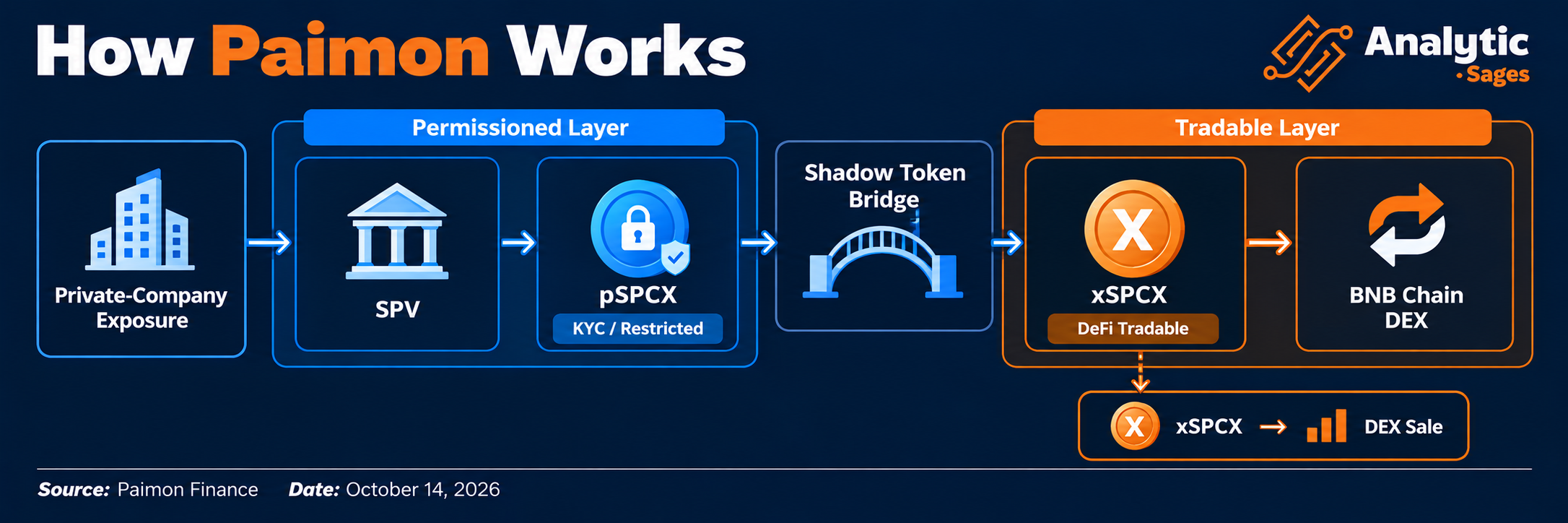
Instead of issuing a single token type, Paimon uses a dual-token model that separates the permissioned investment layer from the tokens available for DeFi trading.
The first is the p-token, such as pSPCX, which operates within the permissioned side of the structure. It uses the EIP-3643 security-token standard, allowing Paimon to enforce identity verification and transfer restrictions for eligible participants.
The second is the x-token, such as xSPCX, which is designed for broader onchain trading. These tokens can be transferred and traded through BNB Chain DeFi markets without requiring every secondary-market participant to go through the same institutional onboarding process.
To connect both layers, Paimon uses what it calls a Shadow Token Architecture. Under this model, permissioned tokens are locked in a bridge while their corresponding tradable tokens circulate onchain.
In simple terms, the process works like this:
Private-company exposure → SPV → permissioned p-token → bridge → tradable x-token → DEX
However, buying the x-token does not mean owning shares in the underlying company. Holders receive contractual economic exposure through Paimon's investment structure, without the direct shareholder rights that would come with owning those shares.
Another important distinction is how investors exit.
While ordinary users can sell their x-tokens through available DEX liquidity, redeeming against the underlying private-market investment is subject to eligibility, lockups and the terms of each product.
For example, Paimon's SpaceX product includes a post-IPO conversion and redemption framework subject to a six-month lockup and other conditions. Its OpenAI product, on the other hand, has discretionary redemption windows tied to future liquidity events, which are not guaranteed.
The backing also differs between assets. For SpaceX, Paimon publishes a DigiFT holdings statement and describes its exposure as coming through a third-party VC SPV. Its OpenAI product is linked to profit participation units rather than ordinary company shares.
This distinction matters because even though both tokens provide exposure to private companies, the actual rights and underlying assets are not necessarily the same.
Onchain Drivers
Paimon's onchain growth is currently driven by two different businesses: its Paimon Prime yield product and its newer pre-IPO token market.
The larger pool of capital sits in Paimon Prime. In February 2026, the protocol had about $430,000 in TVL, but that grew to roughly $11 million by April before reaching $13.44 million in September.
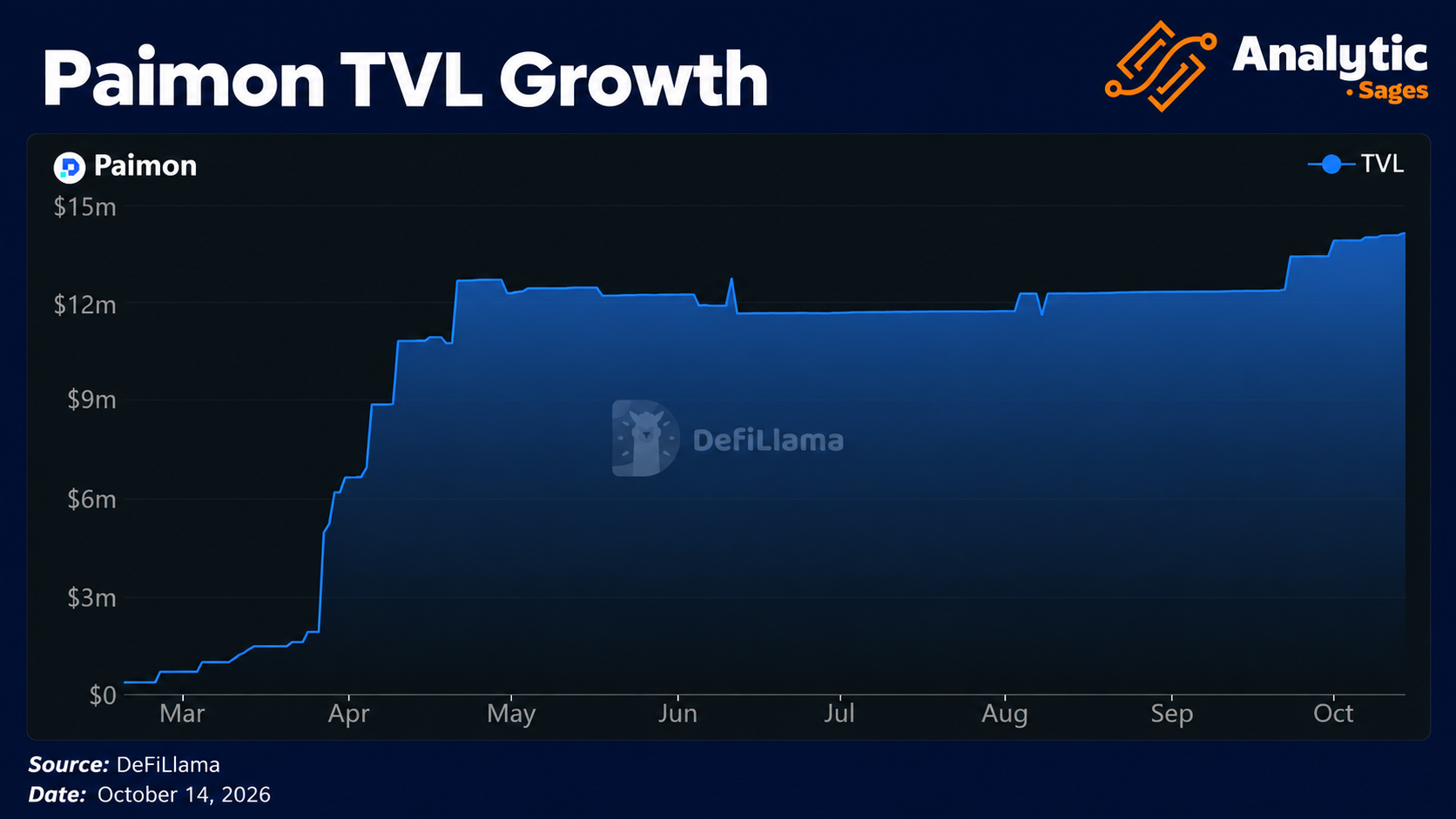
Most of this capital is concentrated in its Hydra yield strategy, making private-credit yield the platform's largest onchain business by value locked.
But its pre-IPO market is also beginning to attract interest.
By September 29, Paimon's four tradable assets — SpaceX, OpenAI, Kalshi and Polymarket — represented approximately $9.97 million in tokenized value at mark prices, compared with $14.94 million at DEX prices.
That difference matters because it shows the market valued some of these tokens well above Paimon's reference prices.
Adoption has also been concentrated around newer listings.
For instance, Polymarket attracted more than 5,500 holder positions within its first few trading days, while its main pool generated approximately $2.45 million in cumulative trading volume during the first six days.
However, the liquidity supporting this activity remains relatively thin.
Across the four assets, the main trading pools held approximately $560,000 in combined liquidity and recorded around $190,000 in daily trading volume at the September snapshot.
Asset Analysis
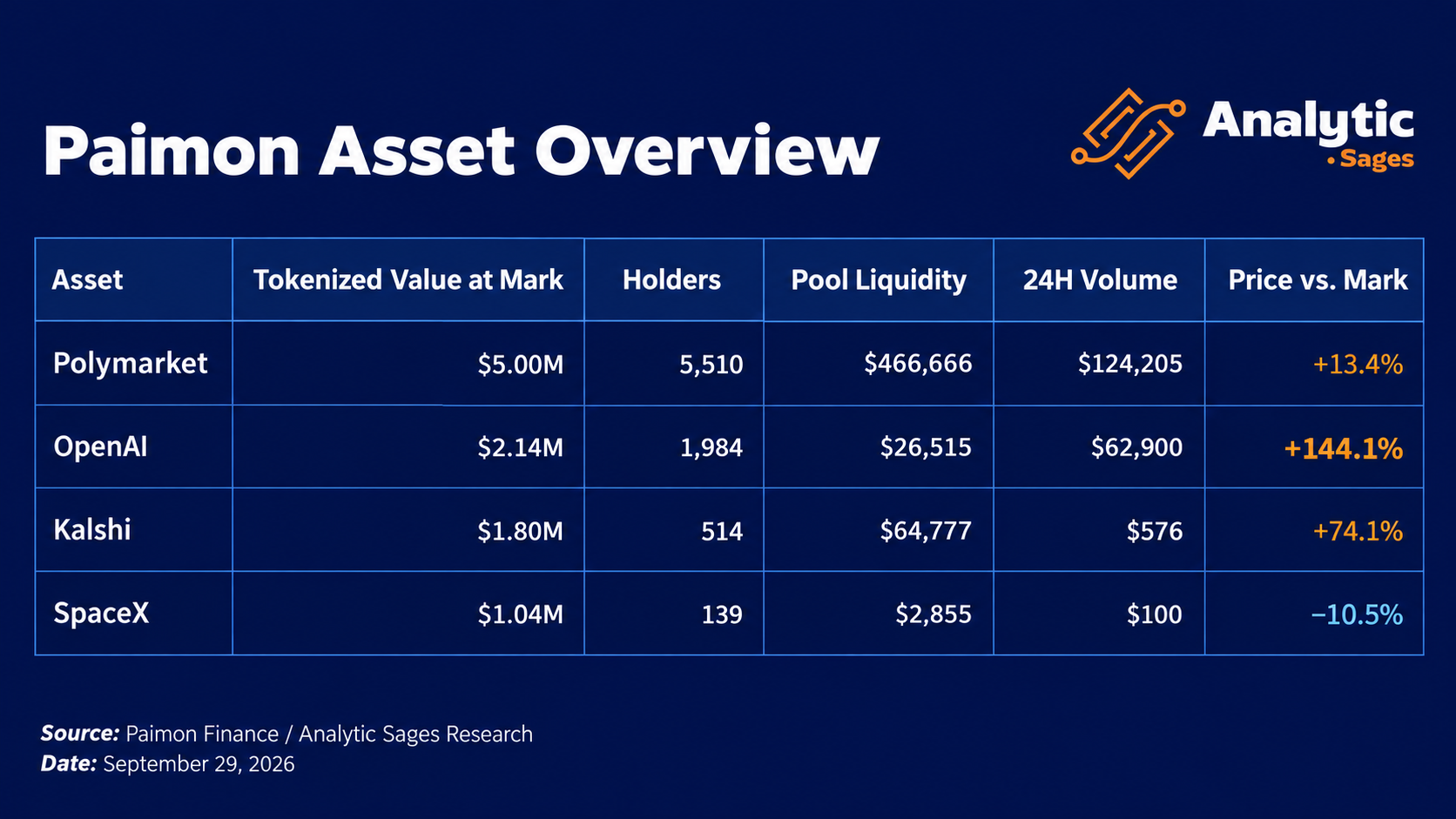
As mentioned earlier, Paimon's pre-IPO market is still heavily concentrated around a few assets, with Polymarket attracting the most attention in the September trading snapshot.
At the time, pPOLY accounted for roughly half of Paimon's tokenized pre-IPO value at mark prices and more than two-thirds of its summed holder positions.
That's particularly interesting because Polymarket was one of the newest additions to the platform.
Within its first six trading days, the token attracted more than 5,500 holders and generated approximately $2.45 million in trading volume through its main pool.
OpenAI showed a different pattern. Despite having fewer than 2,000 holders and only $26,500 in main-pool liquidity, xOPAI recorded approximately $62,900 in daily trading volume.
SpaceX, meanwhile, had just 139 holders and less than $3,000 in main-pool liquidity, showing how much activity had shifted toward newer listings.
But another interesting finding was how differently these assets traded against Paimon's reference prices. OpenAI traded at a 144% premium to its mark price, while Kalshi was more than 70% above its reference valuation. Polymarket traded at a smaller premium of around 13%, while SpaceX was at a slight discount.
For OpenAI, that meant buyers were paying more than twice the platform's reference valuation for the underlying exposure.
With relatively shallow liquidity in some of these pools, prices can move significantly without a corresponding change in the underlying private-company investment's value.
PreStocks vs Paimon: Comparative Analysis
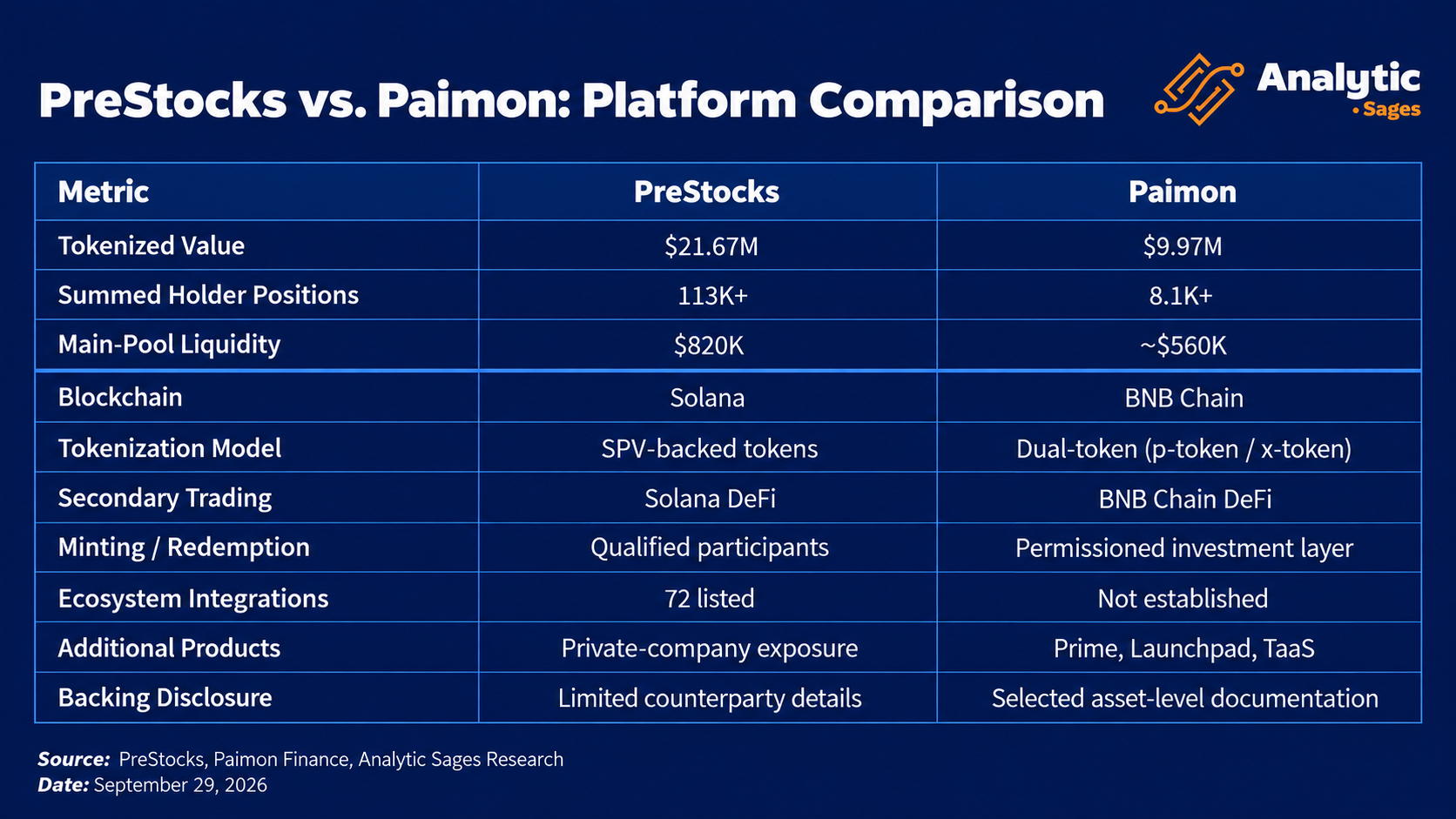
PreStocks and Paimon are both bringing private-company exposure onchain, but they are building toward different positions in the market.
PreStocks has taken a more focused approach. It creates tokenized exposure to private companies and distributes those assets across Solana's DeFi ecosystem.
Paimon, by contrast, is building a broader business that combines private-company investments, institutional yield products, and tokenization infrastructure for other asset issuers.
The difference becomes clearer when we compare their adoption.
In our September 29 snapshot, PreStocks had approximately $21.67 million in tokenized market value, compared with $9.97 million for Paimon's four tradable pre-IPO assets at mark prices.
PreStocks also had more than 113,000 summed holder positions, compared with just over 8,100 on Paimon. But the liquidity gap was much smaller.
Despite having more than twice Paimon's tokenized value and roughly fourteen times its holder positions, PreStocks' main pools held only $820,000 in liquidity, compared with approximately $560,000 on Paimon.
Much of Paimon's liquidity came from Polymarket, so the gap would widen considerably if we excluded that single asset.
However, the bigger distinction between the two platforms is how they structure and distribute their products.
PreStocks connects its tokens to private-company exposure held through SPVs and other holding entities. Qualified participants handle minting and redemption, while ordinary users trade the tokens across Solana.
Its distribution network has also grown considerably. PreStocks currently lists 72 ecosystem integrations, covering trading platforms, wallets, analytics providers, liquidity venues, and other applications.
Jupiter, Meteora, Raydium, Phantom, Coinbase Wallet and Binance Wallet are among the platforms listed in its ecosystem.
Paimon uses a different approach. Its dual-token structure separates the permissioned investment layer from freely tradable tokens, while the Launchpad lets users participate in private-market offerings.
The platform also operates a points system where users can earn points through staking, liquidity provision, and other activities. These points determine eligibility and access tiers for certain Launchpad offerings.
Beyond private-company exposure, Paimon Prime offers another business built around institutional private-credit yield, while its Tokenization-as-a-Service arm targets funds and asset owners looking to bring their own investments onchain.
The platforms also differ in how they disclose the assets behind their tokens.
PreStocks describes its tokens as backed by exposure to private-company shares held through SPVs or other investment entities, but it generally provides limited detail on the underlying counterparties.
Paimon provides supporting documents for selected assets, including a DigiFT holdings statement associated with its SpaceX exposure. However, that does not mean every Paimon token has the same level of independent backing documentation.
So, while PreStocks is building a larger distribution network around tokenized private-company assets, Paimon is trying to combine issuance, investment access, yield, and other services within one ecosystem.
Both approaches have advantages, but the long-term test will be whether these assets can attract sufficient liquidity, maintain credible backing, and give users reasons to hold them beyond speculation on private-company valuations.
Conclusion
The clearest takeaway is that tokenized pre-IPO markets are no longer just an experiment around access.
PreStocks has shown growing demand for private-company exposure onchain, while Paimon is taking a broader approach by combining these assets with institutional yield products and tokenization infrastructure.
But despite this progress, the market still faces some important challenges.
Liquidity remains relatively thin, token prices can trade significantly above or below their underlying reference valuations, and much of the exposure still depends on off-chain structures that ordinary tokenholders have limited visibility into.
And this is where the next stage of growth becomes interesting.
Bringing private companies onchain is one thing, but building markets where investors can confidently trade, understand what backs their tokens, and exit their positions is another.
For both platforms, the long-term opportunity will depend not just on how many assets they tokenize or how much trading activity they attract, but on how well they address these challenges as the market grows.
Disclaimer
This research is provided for informational and educational purposes only and should not be considered financial, investment, legal, tax, or trading advice.
Analytic Sages makes reasonable efforts to ensure that the information, data, and analysis presented are accurate at the time of publication. However, markets, protocols, regulations, and onchain data can change quickly, and third-party information may be incomplete, delayed, or subject to revision.
Any views, interpretations, or conclusions expressed are based on the available data and research methodology at the time of publication and should not be treated as guarantees of future performance or outcomes.
References to tokens, protocols, companies, funds, or financial products do not constitute an endorsement or recommendation to buy, sell, or hold any asset. Readers should conduct their own research and, where appropriate, consult qualified professional advisers before making financial or investment decisions.
Past performance is not indicative of future results.
Authors and contributors
Modestus Okoye
Primary author · Editor
zayd.web3
Contributor · Author