

Research
The State of Robinhood Chain
Three months after Robinhood Chain launched, what is actually driving its growth? We look at the network’s fundamentals and onchain data to find the signals that matter most.

Contributors
Modestus Okoye
Overview
Robinhood Markets, founded in 2013 by Vlad Tenev and Baiju Bhatt, was built around commission-free U.S. equity trading.
In its first decade, it was known primarily as a retail brokerage, although they began expanding into crypto in 2018 with BTC and ETH pairs. However, the launch of Robinhood Chain in 2026 marked a deeper move into financial infrastructure, taking it beyond giving users access to markets to building the rails those markets run on.
Robinhood Chain is an EVM-compatible Ethereum L2 built using Arbitrum Nitro. It launched its public testnet in February 2026 before opening mainnet on July 1, with tokenized assets positioned as the network's flagship use case.
The move onchain changed how Robinhood’s equity products could be used. Unlike its EU stocks offering, which largely stayed inside the Robinhood application, the newer assets could move through DeFi and be integrated into third-party protocols.
Less than a month after mainnet launch, Robinhood Chain was averaging roughly $29.7 million in daily tokenized-stock DEX volume, exceeding the combined volume reported for Solana’s xStocks and Backpack Sunrise venues at the time.
Tokenized assets also began appearing as liquidity and quote assets in crypto-native markets, extending their use beyond simply tracking equity prices.
Its broader onchain stack includes:
- Tokenized assets: U.S. stocks and ETFs brought onchain so they can move beyond the Robinhood app and interact with DeFi.
- Robinhood Earn: gives users access to stablecoin yield through onchain lending markets.
- Robinhood Wallet: the main self-custodial entry point into Robinhood Chain, including tokenized assets, swaps, and DeFi.
- Perpetuals: Robinhood uses Lighter to give eligible non-U.S. users access to onchain perp trading.
DeFi on Robinhood
One of the most interesting things about Robinhood is how it distributes capital across lending, DEXs, and derivatives.
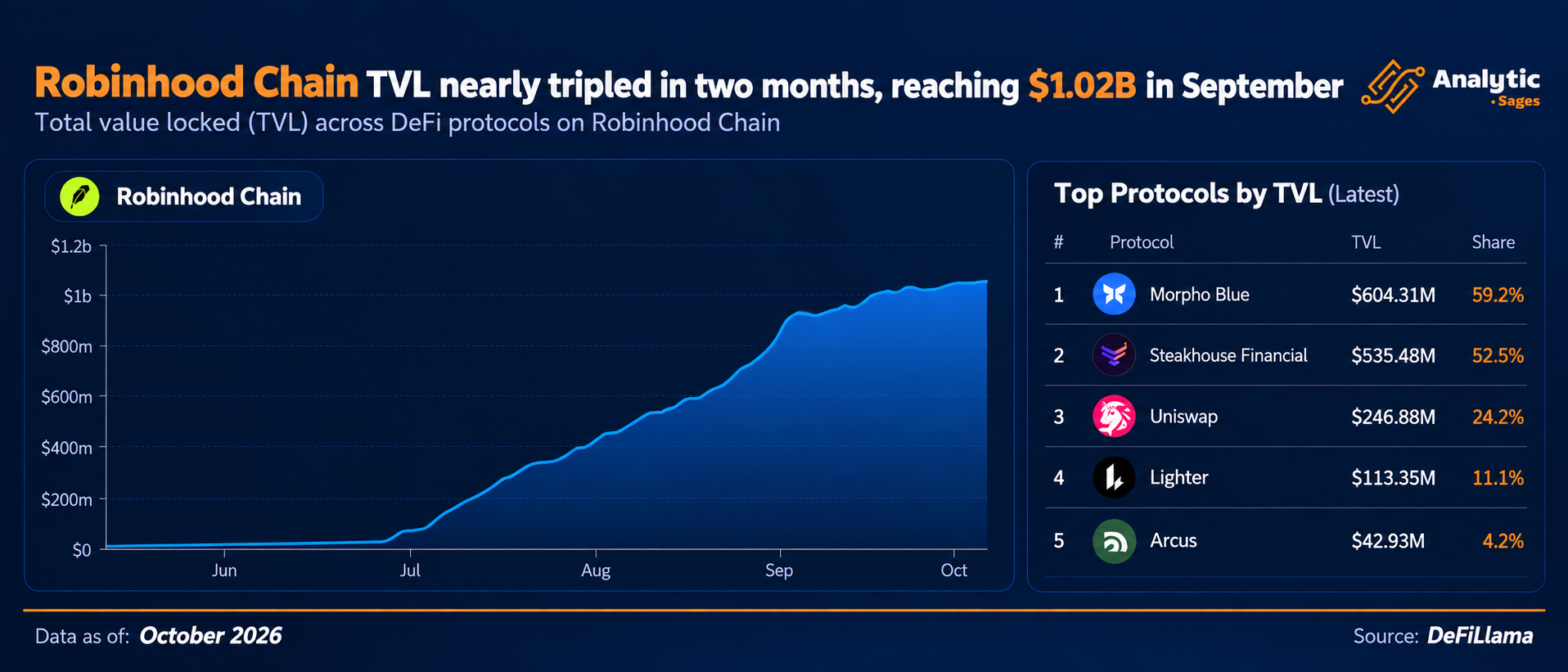
Unlike most chains, more than half of the network’s DeFi capital currently sits in Morpho, making it the dominant lending venue, and that capital is not simply sitting idle. By the end of September, Morpho had roughly $456 million in outstanding loans and more than $500 million supplied across lending markets, with Robinhood Earn and Merkl incentives helping to attract liquidity into the system.
The DEX side also saw a shift in dominance. Uniswap’s share of Robinhood Chain DEX volume fell from 96.5% in July to 80.6% in September as Pons, Fables, and Ramses gained traction and gradually took some share.
Even with that decline, Uniswap V4 still looks like one of the most important pieces of trading infrastructure on the network. For instance, Pons graduates tokens into V4 pools, while other applications also build directly on it, although Uniswap V2’s share of volume fell to 2.6% in September as V4 climbed to 34.9%.
Later in September, trading activity began to shift.
Spot DEX volume peaked at roughly $17.2 billion in the week ending Sept. 6, before falling to about $9.3 billion by Sept. 27th, while perps moved the other way, rising from roughly $2.4 billion to $4.6 billion over the same period and increasing its share of combined spot and perpetual volume from about 12% to roughly one-third.
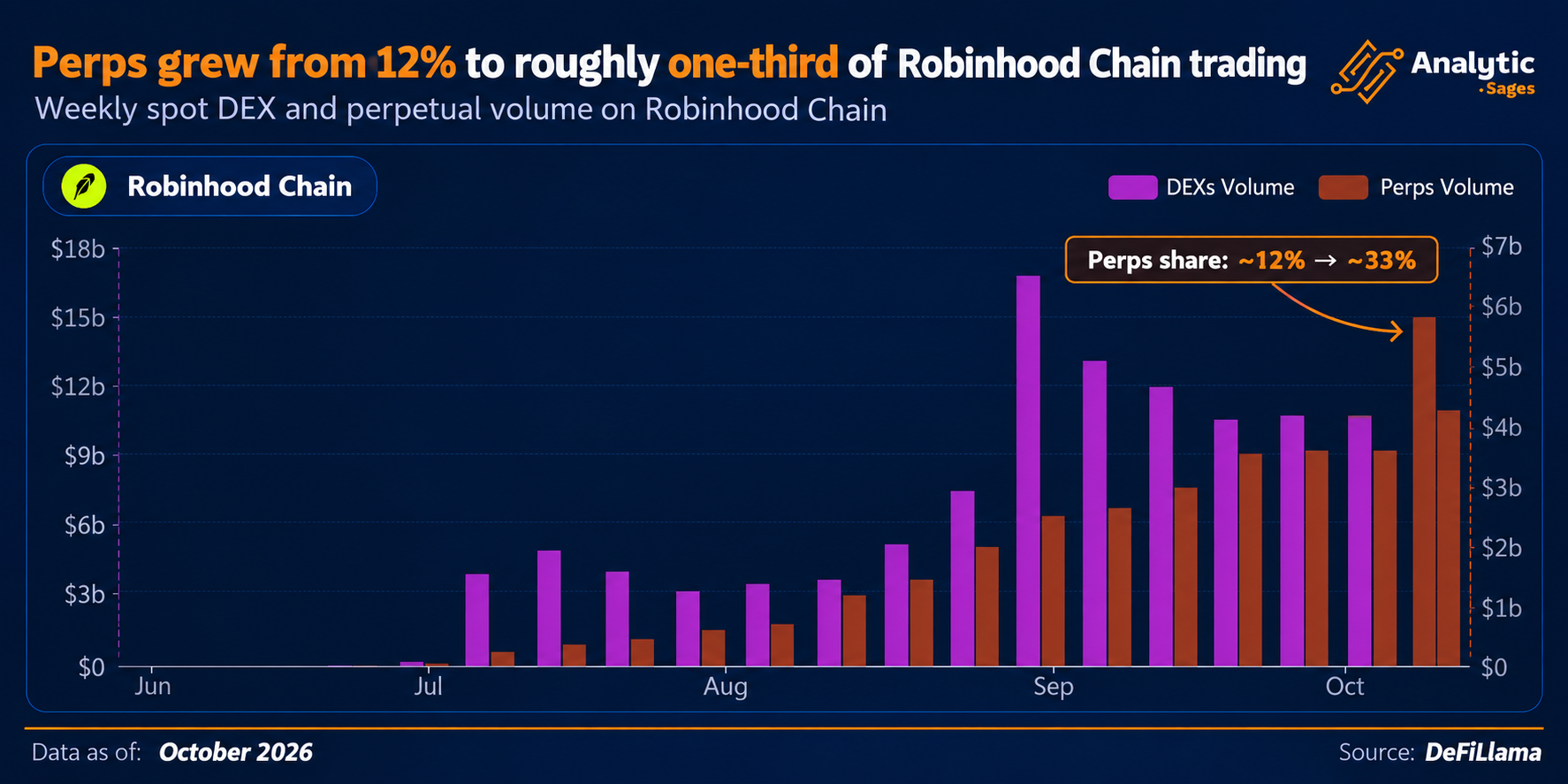
Part of that shift came as the early-September spot and memecoin surge cooled, while Robinhood’s Lighter integration and the 11 million LIT incentive allocation gave derivatives activity more room to grow.
Stablecoins
Stablecoins became a major source of capital on Robinhood Chain, with supply doubling in roughly two months to about $1.06 billion by the end of September.
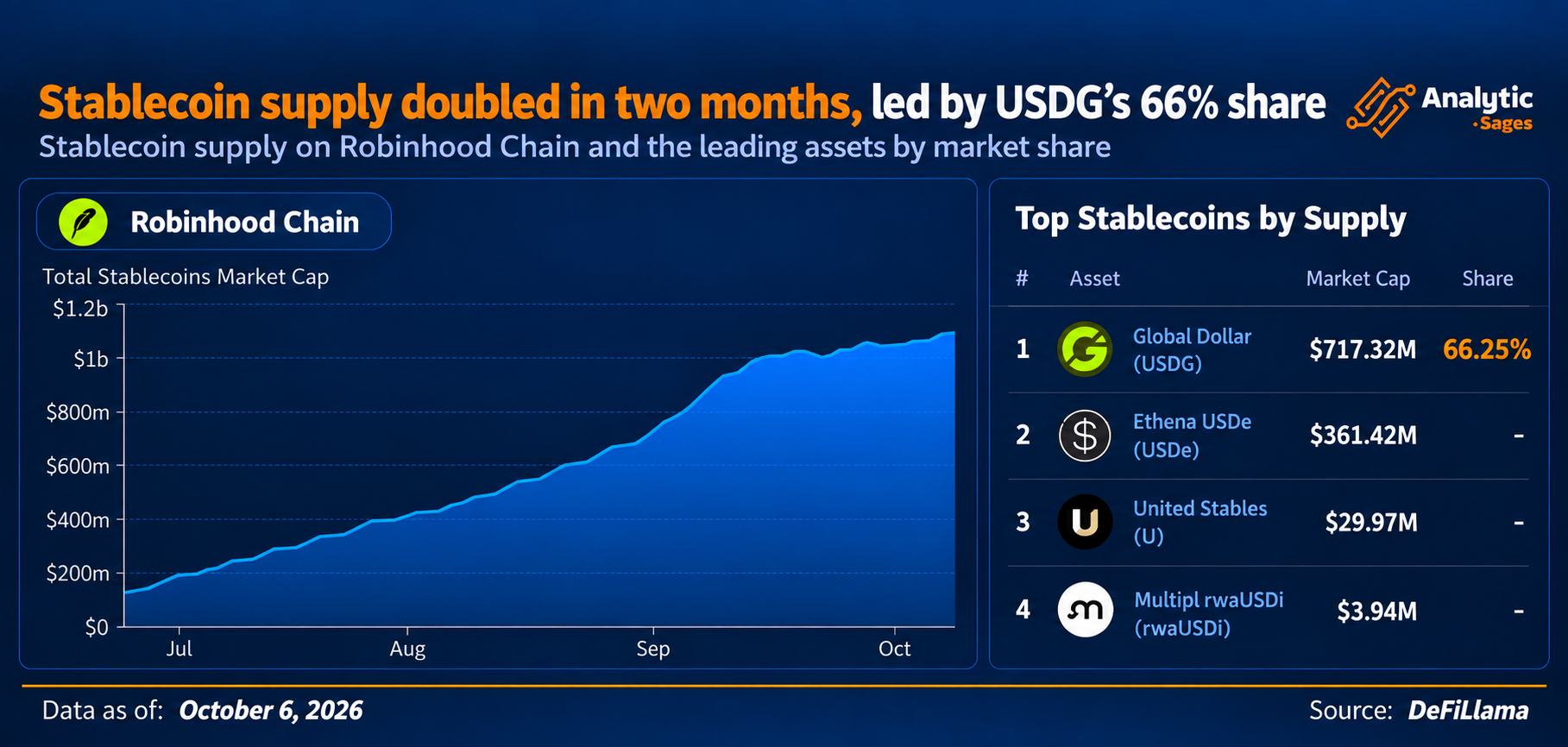
USDG remained dominant at roughly 66.6% of supply, while USDe accounted for most of the remainder. Their dominance is closely tied to Robinhood’s lending structure, where USDG sits at the center of Robinhood Earn and Steakhouse’s Morpho vaults, and USDe is one of the largest collateral assets used across those markets.
The rest of the stablecoin market remained comparatively small. United Stables (U) reached roughly $30 million, while rwaUSDi held about $3.9 million, with other assets contributing little to overall supply. In practice, almost all stablecoin liquidity on Robinhood Chain is still concentrated in USDG and USDe.
The pace of new capital also began to cool toward the end of September. Weekly inflows remained positive through most of July and August and surged above $200 million in early September, then fell sharply and turned slightly negative near month-end.
Stablecoin market cap has since flattened around $1.04 billion, so a renewed rise in inflows would be one of the first signs that activity is picking up again.
RWAs on Robinhood
Tokenized assets are supposed to be one of Robinhood Chain’s defining use cases, but so far they have attracted far less capital than the lending side of the network.
At September’s close, tokenized stocks on Robinhood Chain were worth roughly $148 million, representing about 4.6% of the global tokenized-stock market and placing Robinhood around sixth among the major platforms and networks tracked by RWA.xyz.
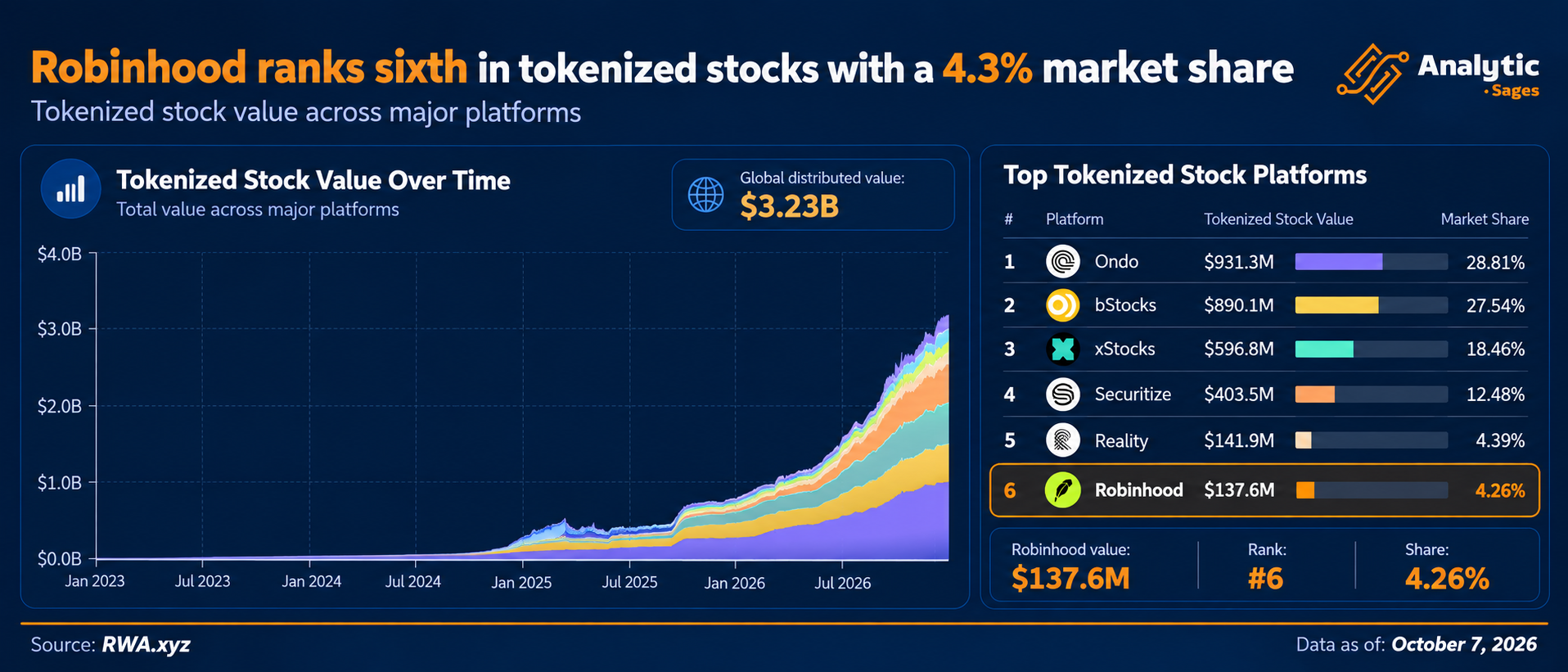
Robinhood’s incentive structure has also leaned much more heavily toward stablecoin and yield products. Even though tokenized assets remain central to how the company presents the chain, Robinhood-linked campaigns were paying roughly 18 times more toward stablecoin yield than tokenized-stock liquidity.
These assets have shown more progress, however, in becoming useful beyond simply tracking an equity's price.
For instance, meme-stock pairings emerged on Robinhood Chain, where tokenized stocks such as SPY and NVDA can sit on the other side of a memecoin pool. At the peak of that trend in early September, these pools accounted for roughly one-third of tokenized-stock DEX trading, showing that the use case had become meaningful rather than remaining a niche experiment.
Their use has also extended into lending. By late September, 171 Morpho markets had accepted tokenized stocks as collateral, although only about $3 million was actually deposited across them.
And this direction is starting to show up elsewhere as well. Aave V4 on Base launched an Equities Hub where seven Coinbase tokenized U.S. stocks, including AAPLc, MSFTc and NVDAc, can be deposited as collateral to borrow USDC in September.
Network Activity and Financials
Robinhood Chain’s network activity grew quickly after launch, but usage did not move in a straight line.
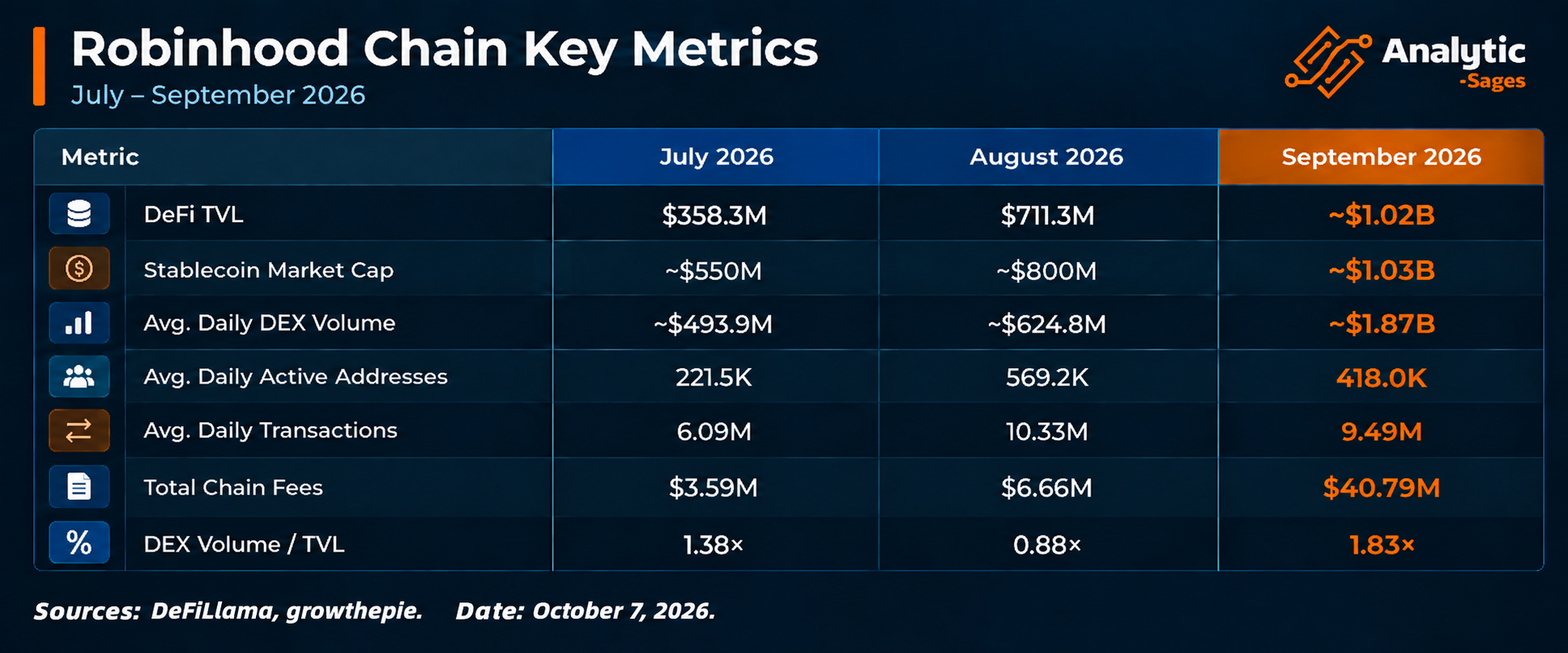
Average daily active addresses rose from about 221,500 in July to 569,000 in August, before easing to roughly 418,000 in September. Average daily transactions followed a similar pattern, increasing from about 6.1 million to 10.3 million, then slipping to 9.5 million in September.
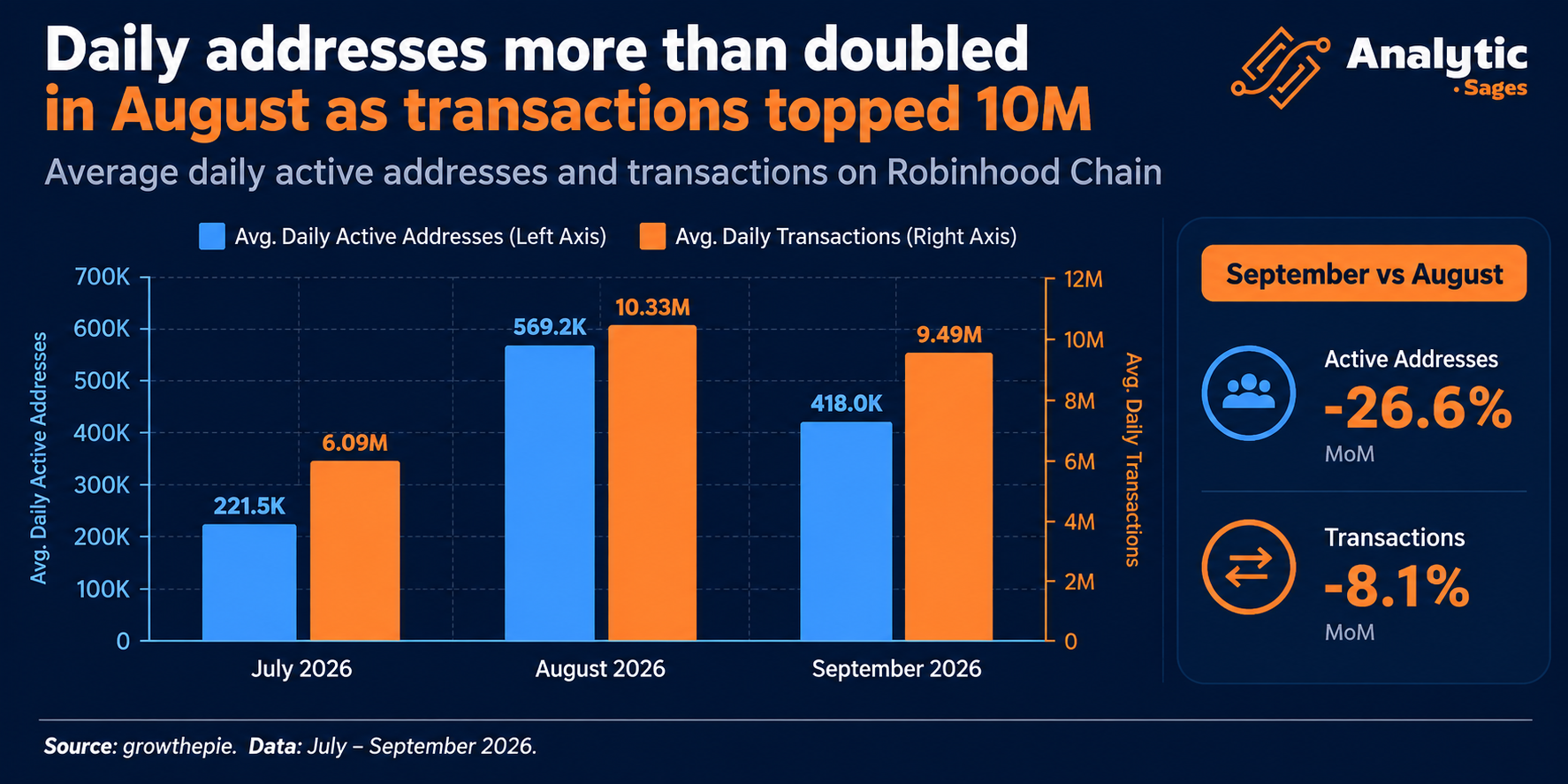
From a user-activity perspective, August remains the stronger month. More addresses were active, and more transactions were being processed each day, even though September later became much stronger for trading and fees.
The financial side moved very differently. Chain fees nearly doubled from July to August, before jumping to about $40.79 million in September, more than six times the previous month. Even that September figure was heavily concentrated, with roughly 75.6% of the month’s fees generated in the first seven days.
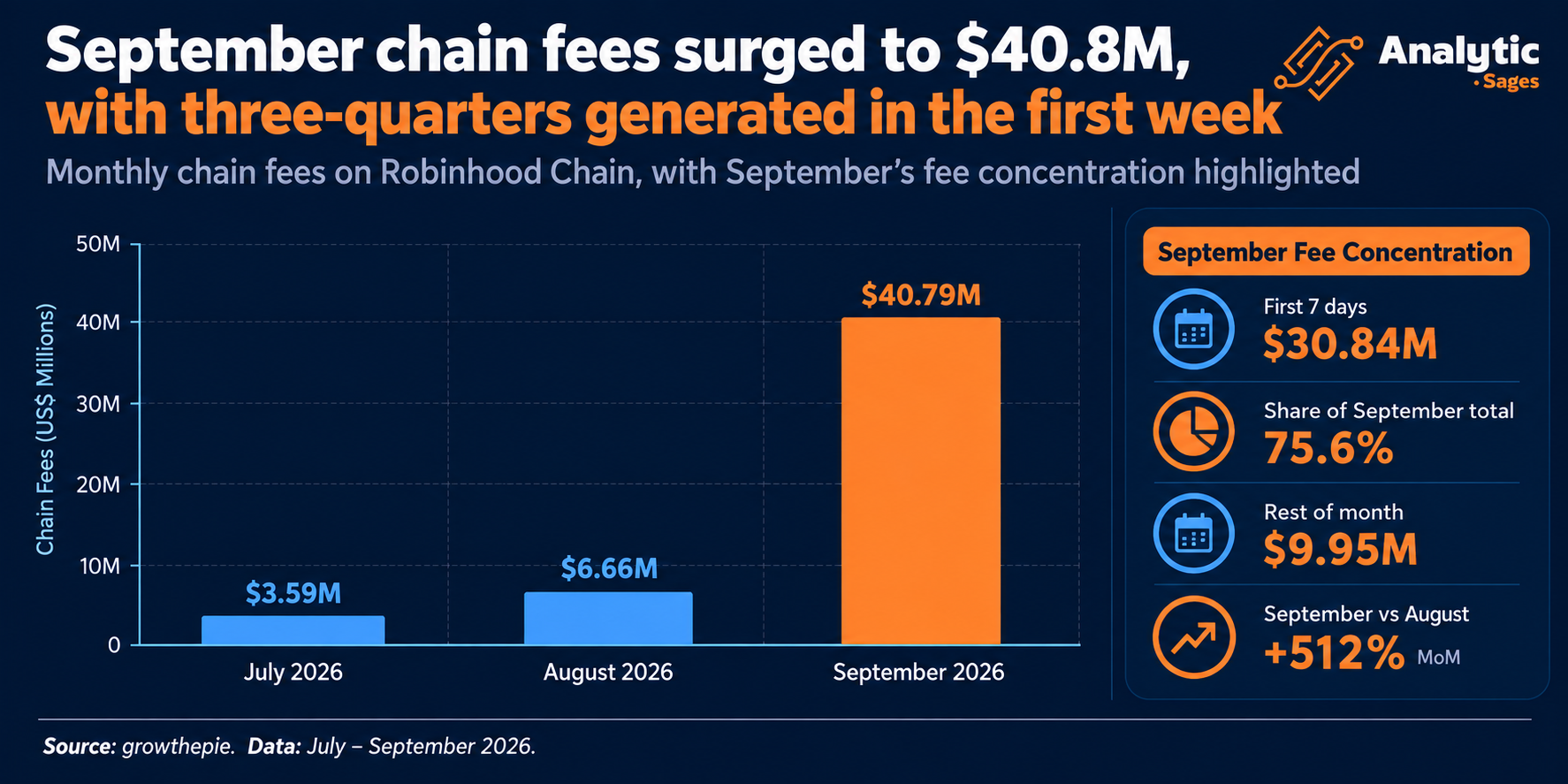
The timing lines up with the height of Robinhood Chain’s memecoin boom, led largely by launchpads such as Pons.
During the first week of September, Pons became one of the biggest fee-generating applications in crypto, while activity across other launchpads such as Long.xyz also accelerated.
What Comes Next
One of the clearest takeaways from Robinhood’s recent keynote is that the current tokenized asset offering is still only a small part of what the company wants to bring onchain.
More stocks, ETFs, and eventually other asset classes should naturally expand the value of Robinhood’s tokenized market, but tokenization itself is only the starting point.
Platforms like Ondo, Backed and Backpack are already pushing in the same direction, so simply having more assets will not be enough to separate one platform from another.
The more important signal will be how deeply those assets become integrated into the rest of the market, either as collateral, liquidity, quote assets or eventually inside more complex financial products.
That is where Robinhood’s tokenized assets will really start to matter.
The bigger ambition also appears to go well beyond stocks. Robinhood has been gradually moving more of its financial stack onchain, and products such as perpetuals and, eventually, options could make the chain much more than an RWA venue.
That also puts more attention on the protocols sitting directly in the path of those flows. Lighter is already one of the clearest examples.
Since becoming the default perpetual venue in Robinhood Wallet, Robinhood Chain has become a meaningful source of Lighter’s fees and revenue.
If perp activity continues to expand, it would strengthen Lighter’s fee base and, by extension, the amount of value available to support LIT buybacks. For me, that makes LIT one of the more useful signals to watch as Robinhood pushes more derivatives activity onchain.
The other thing I am watching closely is capital formation itself.
A number of the early growth signals have started to cool at the same time: stablecoin inflows have slowed, user activity is off its August highs and some of the speculative activity that helped push September volumes has faded. A renewed rise across those metrics would say much more about returning interest than another isolated spike in TVL or volume.
This matters even more because a meaningful part of Robinhood’s early DeFi growth has been bootstrapped by incentives. Robinhood Earn, Steakhouse vault rewards, stock liquidity programs, and Lighter’s LIT incentives have all helped pull capital and activity onto the chain.
The real question is what happens when some of those incentives begin to fade. If liquidity, lending activity, and trading volume hold up, then Robinhood will have a much stronger case that it has converted subsidized growth into more durable demand.
Over the next few months, these are the signals I will be watching most closely as Robinhood Chain moves into its next phase.
Disclaimer
This research is provided for informational and educational purposes only and should not be considered financial, investment, legal, tax, or trading advice.
Analytic Sages makes reasonable efforts to ensure that the information, data, and analysis presented are accurate at the time of publication. However, markets, protocols, regulations, and onchain data can change quickly, and third-party information may be incomplete, delayed, or subject to revision.
Any views, interpretations, or conclusions expressed are based on the available data and research methodology at the time of publication and should not be treated as guarantees of future performance or outcomes.
References to tokens, protocols, companies, funds, or financial products do not constitute an endorsement or recommendation to buy, sell, or hold any asset. Readers should conduct their own research and, where appropriate, consult qualified professional advisers before making financial or investment decisions.
Past performance is not indicative of future results.
Authors and contributors
Modestus Okoye
Research Lead · Editor