

Research
Weekly Research Brief 4: Starknet Weighs Ethereum Exit Over Quantum Risk

Contributors
Modestus Okoye, David Abimbola
Starknet Eyes Independent L1 as Ethereum's Quantum Security Timeline Raises Concerns
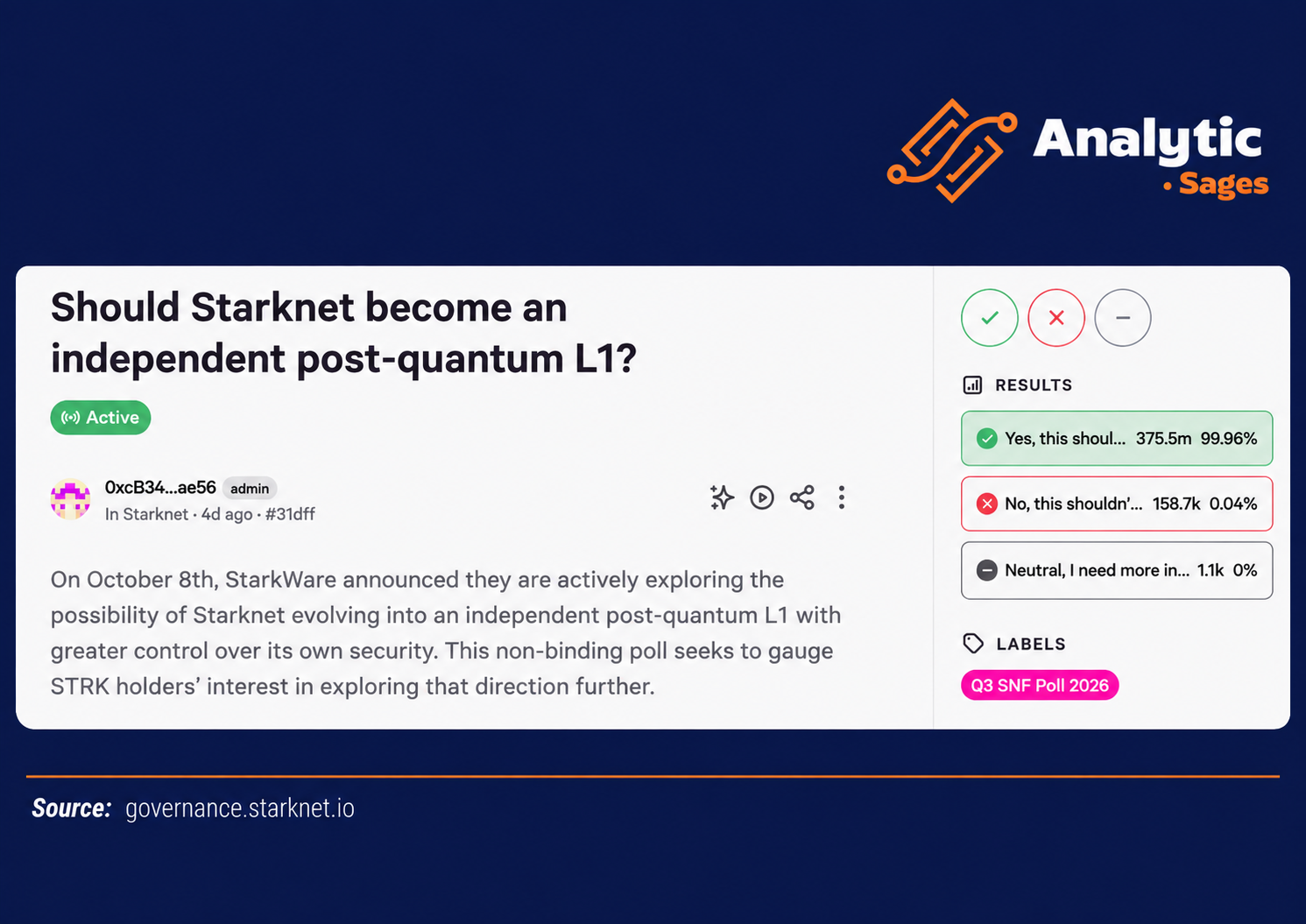
On October 8, Starknet announced that it was considering leaving Ethereum to become a fully quantum-resistant Layer 1, setting 2027 as its target for quantum resistance. A week later, on October 15, it opened a governance vote asking STRK holders whether to explore the transition, marking a potential departure from Starknet's original purpose of scaling Ethereum while relying on its security.
In September, the Ethereum Foundation outlined a roadmap targeting full quantum resistance by December 2029. However, StarkWare believes Starknet cannot achieve complete quantum resistance ahead of Ethereum while its security still depends on the underlying network.
Speaking on a livestream with The Defiant, StarkWare CEO Eli Ben-Sasson argued that an L2 is only as safe as the chain underneath it. Even if Starknet makes its own technology quantum-resistant, vulnerabilities in Ethereum could still expose the network to risks inherited from its underlying L1.
Support for exploring the transition has been strong so far. As of October 17, more than 99.9% of voting power was cast, representing approximately 327 million STRK, backing further research into becoming an independent L1, although 94% of the voting power came from Starknet Foundation-delegated votes.
On the architecture side, Starknet already has an advantage through its STARK proving system, which relies on hash-based cryptography considered resistant to quantum attacks.
However, quantum-resistant proofs alone are not enough. Standard account signatures and other security components still require upgrades, while an independent network would need to establish its own validator security, consensus, and data availability.
Leaving Ethereum therefore presents a trade-off. Starknet could gain more control over its quantum-security roadmap, but it would also give up the security guarantees currently inherited from Ethereum. Whether it can develop an equally robust and decentralized security model remains unanswered. For now, independence remains a proposal for research rather than a proven alternative to Ethereum's security.
PancakeSwap’s Proposed Shift: Will Lower Emissions Make CAKE More Deflationary?
PancakeSwap has introduced The Flip, a governance proposal to increase liquidity providers' (LPs) share of trading fees while reducing CAKE token emissions.
Under the plan, LPs on PancakeSwap v3 and Infinity would receive 88% of swap fees, up from approximately 66–68%, with the remaining 12% allocated to the Treasury. Daily CAKE emissions would also fall by 69%, from 22,500 to 7,000 tokens.
By offering LPs a larger share of trading fees, PancakeSwap hopes to attract more capital, deepen liquidity, and improve trade execution across its 11 supported chains.
Based on its 2025 trading volume, the team estimates that LPs would have earned an additional $62 million under the proposed structure. However, actual earnings would still depend on trading activity and the amount of liquidity competing for those fees.
Alongside the new fee structure, reducing CAKE emissions could limit the number of new tokens entering circulation and ease potential selling pressure from farming rewards. The remaining 7,000 CAKE issued daily would go to the Pantry, PancakeSwap's ecosystem growth fund, rather than the existing farming incentive system.
This proposal also raised concerns among CAKE holders.
Some community members argue that redirecting more trading fees to LPs could weaken CAKE's existing burn mechanism and reduce the value captured by token holders. Others questioned how the proposed 12% Treasury allocation would be used, with calls for a portion to continue supporting CAKE buybacks and burns.
Despite the proposed emissions cut, PancakeSwap expects CAKE's net burn rate to slow. Based on the previous ten weeks of activity, the team estimates that supply would still decline by approximately 190,000 CAKE weekly, or 9.9 million annually. CAKE would therefore remain deflationary under these projections, but at a slower pace than before.
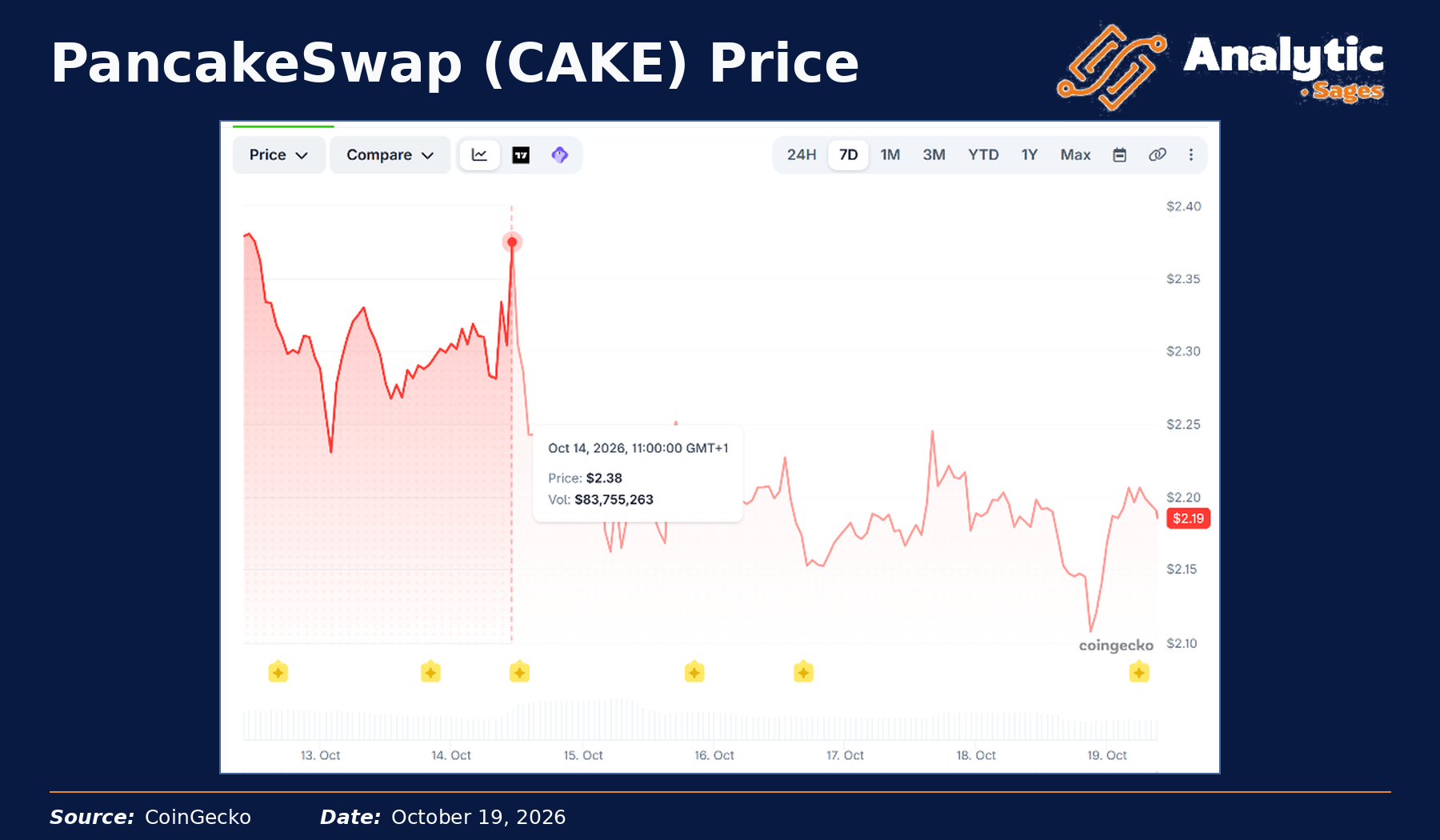
Since PancakeSwap announced The Flip on October 14, CAKE has declined by approximately 4.8%, from $2.30 to $2.19 as of October 18, indicating that lower emissions could improve supply dynamics but do not automatically translate into higher prices.
For now, The Flip remains open for community discussion before a formal governance vote. If approved, implementation is expected to begin in November 2026 and conclude by the end of January 2027.
Disclaimer
This research is provided for informational and educational purposes only and should not be considered financial, investment, legal, tax, or trading advice.
Analytic Sages makes reasonable efforts to ensure that the information, data, and analysis presented are accurate at the time of publication. However, markets, protocols, regulations, and onchain data can change quickly, and third-party information may be incomplete, delayed, or subject to revision.
Any views, interpretations, or conclusions expressed are based on the available data and research methodology at the time of publication and should not be treated as guarantees of future performance or outcomes.
References to tokens, protocols, companies, funds, or financial products do not constitute an endorsement or recommendation to buy, sell, or hold any asset. Readers should conduct their own research and, where appropriate, consult qualified professional advisers before making financial or investment decisions.
Past performance is not indicative of future results.
Authors and contributors
Modestus Okoye
Research Lead · Editor
David Abimbola
Research Analyst · Author