

Blog
Weekly Research Brief 9:MON Set to Unlock 140% of Supply Despite a 42% Decline in the Last 30 Days

Contributors
Modestus Okoye, David Abimbola
Monad’s Biggest Unlock Resurfaces the Low-Float Model Argument, but Is It Already Priced In?
MON is heading into one of its largest supply expansions since launch.
Tomorrow, about 16.6 billion MON is scheduled to unlock against roughly 11.8 billion currently in circulation. The team receives the largest allocation at about 10.7 billion MON, followed by 4.9 billion for investors and roughly 987 million for the Category Labs treasury.
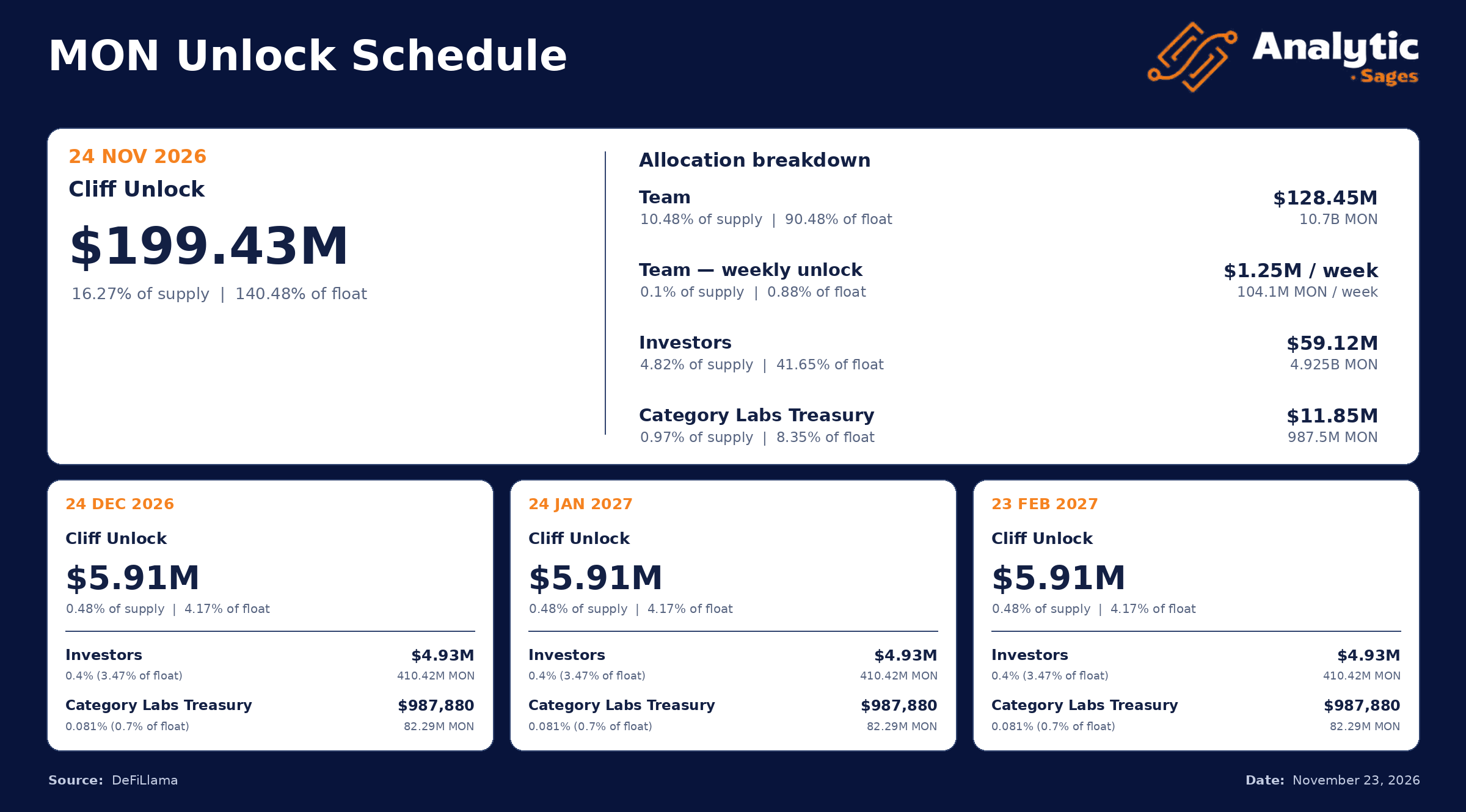
This brings back an argument that followed Monad even before launch: the problem with low-float tokens.
Only a relatively small portion of MON was made available to the public at launch, while much larger allocations for the team and investors remained locked.
Arthur Hayes, one of the early critics, pointed to this as one reason for having little conviction in holding these kinds of tokens even when the fundamentals look good, since it is difficult to know what happens once large insider allocations eventually become available to the market.
Tomorrow gives us the first major test of that argument.
But perhaps the more useful question going into the unlock is whether traders have already been preparing for it.
MON is down about 43% over the last 30 days and 56% over the last three months, a decline that is steeper than the broader market. Bitcoin, for comparison, is down roughly 27% over the past month.
At the same time, DeFi TVL on Monad currently sits around $785 million, roughly 20% below its October peak of about $983 million.
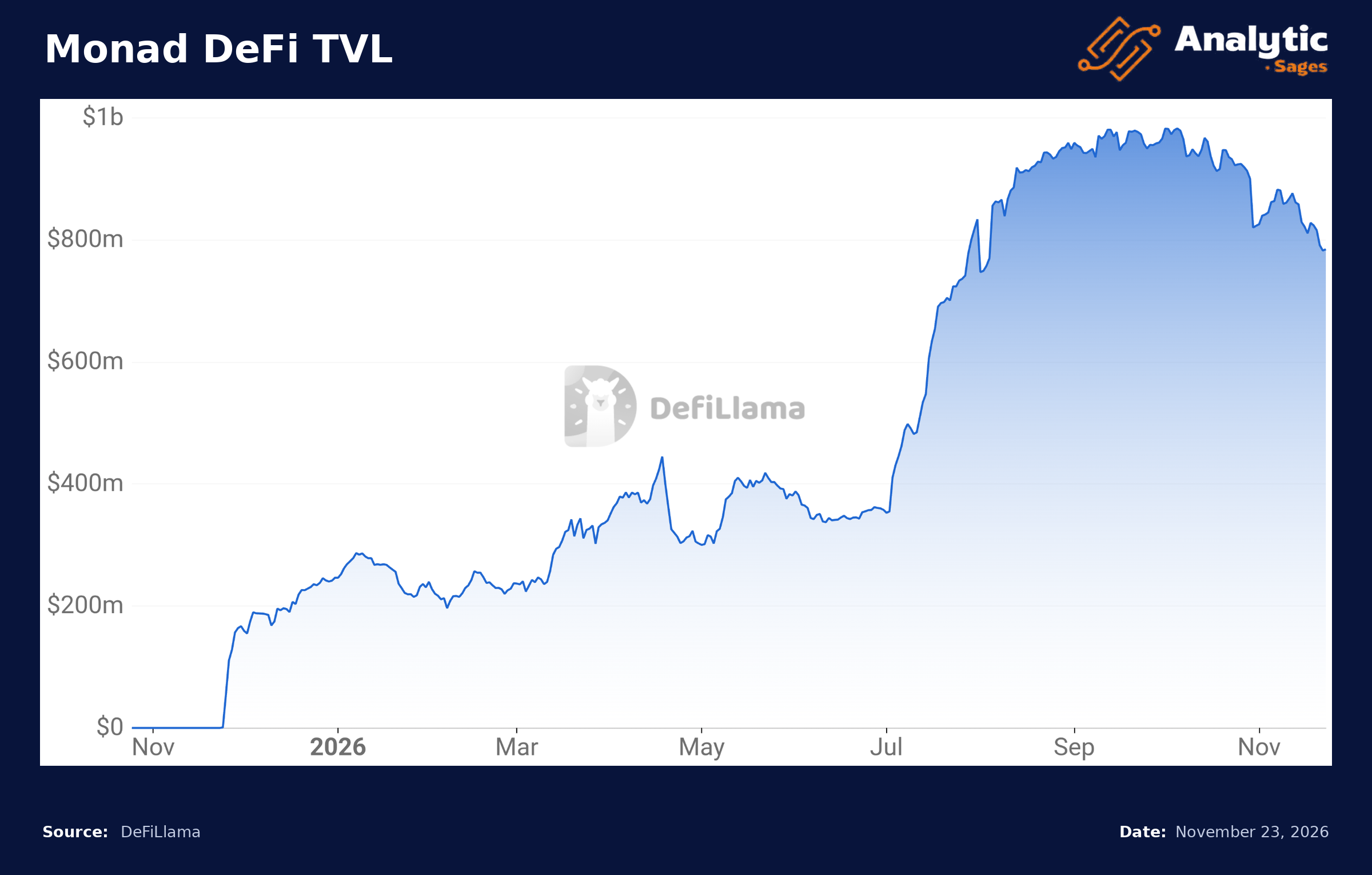
That divergence suggests MON's price has weakened much faster than activity on the network itself, which could mean traders have already been reducing exposure ahead of the unlock.
Derivatives positioning gives a more mixed picture.
MON currently has about $52 million in open interest, equivalent to roughly 36% of its market cap. Funding, on the other hand, has remained close to neutral rather than moving deeply negative.
So there is little evidence yet of an extreme rush to short the unlock, although recent data showing price falling while coin-denominated open interest rises suggests some new shorts are beginning to enter.
That could change quickly once the tokens become available, which is why liquidity becomes important.
MON currently averages around $15 million in daily spot volume, compared with roughly $205 million worth of MON scheduled to unlock.
If 10% of the unlock were to be sold, it would be worth roughly $20 million at current prices, already above MON's average daily spot volume.
We do not expect all of that selling to happen tomorrow, which is why we will be keeping tabs on token distribution and wallet behaviour after the unlock.
Since the team controls about 64% of the unlocked allocation, one of the first things to watch is what happens to those tokens after they become available.
If they remain in team-controlled wallets, are moved into custody, or are re-locked, the immediate supply pressure could be much lower than the headline unlock suggests, but if large amounts begin moving towards exchanges, the market will have a much bigger liquidity test to absorb.
Anthropic Records 2.6x SpaceX’s First-Day Onchain Volume Despite Weak Market Conditions
One of the most anticipated IPOs globally took place last week.
True to the hype around it, Anthropic attracted significant demand both in traditional markets and onchain.
Within minutes of going public, several tokenized versions of ANT went live across platforms, with Backpack launching its version just nine minutes after Anthropic's first Nasdaq trade, followed by Ondo, xStocks, and Securitize shortly after.
But the amount traded onchain is what caught our attention.
According to Sunrise, Backpack's tokenized ANT recorded about $134.7 million in trading volume during its first 24 hours on Solana. Its tokenized SpaceX product, SPCX, recorded about $51 million during its own first 24 hours after SpaceX went public in June.
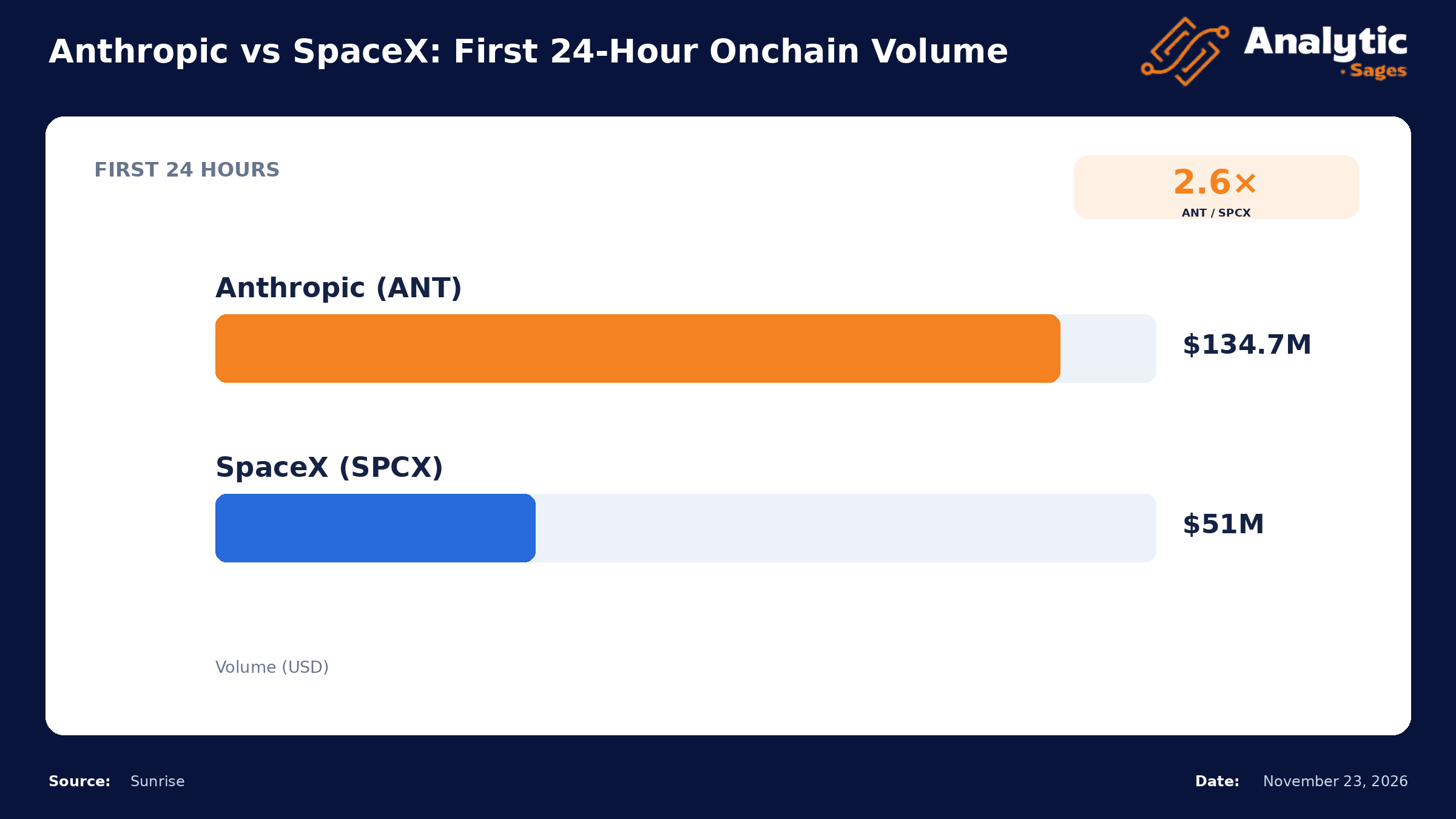
That puts Anthropic's first-day volume at roughly 2.6 times SpaceX's, despite arriving during weaker market conditions. The Nasdaq fell 2.25% on the day of Anthropic's IPO, marking its sixth consecutive losing session.
This adds another signal of where tokenized equities could be heading.
Just as memecoins attracted large numbers of users and liquidity onchain, tokenized assets could gradually become a much bigger market, giving early platforms like Backpack, Ondo, xStocks and Securitize an opportunity to establish themselves as major venues for that activity.
Also, the value proposition for 24/7 trading became clearer.
In a later analysis of ANT trading, Sunrise found that about 36% of more than $170 million in pool volume occurred while Nasdaq was closed. This means a meaningful portion of the activity happened when investors could not trade the underlying stock through traditional markets.
The next major test could be OpenAI.
OpenAI has ruled out an IPO in 2026, but its president Greg Brockman recently said the company could be ready to go public in 2027. If that happens, it gives us another opportunity to see whether first-day onchain demand continues to grow beyond what we have now seen with SpaceX and Anthropic.
LayerZero’s Pre-Staking: Is It Wise to Lock ZRO Now?
As part of Zero's mainnet rollout, LayerZero's pre-genesis staking goes live today, allowing holders to delegate ZRO to validators that will help secure the network from launch.
Those tokens will remain locked until March 31, 2027, with no early exit or liquid staking token, which brings up a simple question: why lock ZRO now instead of keeping it liquid?
The first thing to consider is the reward.
Zero targets a 1% annual inflation rate for staking rewards, shared based on how much ZRO is staked and how long it remains locked.
With ZRO's total supply at 1 billion, that works out to roughly 10 million ZRO in annual emissions. Over the next four months, about 3.5 million ZRO could be emitted before the validator's 10% commission.
From this structure, validators sit at the better end of the economics because their 10% commission is fixed, while what individual stakers earn depends on how much ZRO eventually enters the staking pool. The more tokens that get staked, the more participants compete for the remaining rewards.
But the reward cannot be looked at separately from ZRO's price.
ZRO currently trades around $1.18, roughly 84% below its all-time high and about 31% lower over the last 30 days. Someone buying and staking today is therefore entering after a significant repricing compared with earlier holders, which makes the entry look better than it would have closer to previous highs.
There is, however, another event coming just one week after staking begins.
About 183 million ZRO held by the LayerZero Foundation becomes unlocked on November 30 when Zero mainnet launches. LayerZero says those tokens will be used conservatively for ecosystem development, so this does not mean all 183 million ZRO will suddenly enter the market.
Still, how those tokens are handled matters. If a meaningful amount eventually moves into the market, the additional supply could put more pressure on price, and anyone already staked would have no option to exit until March.
This makes the timing of staking more important.
For someone already planning to hold ZRO through March, staking could make sense because the tokens would otherwise remain idle. But for someone considering buying ZRO mainly because staking has launched, the reward alone may not be enough reason to lock immediately.
Over the next few days, the more useful things to watch will be how much ZRO enters staking, how the Foundation allocation is handled, and how price reacts around mainnet. Those should give a clearer picture of whether locking ZRO now is worth the trade-off.
Disclaimer
This research is provided for informational and educational purposes only and should not be considered financial, investment, legal, tax, or trading advice.
Analytic Sages makes reasonable efforts to ensure that the information, data, and analysis presented are accurate at the time of publication. However, markets, protocols, regulations, and onchain data can change quickly, and third-party information may be incomplete, delayed, or subject to revision.
Any views, interpretations, or conclusions expressed are based on the available data and research methodology at the time of publication and should not be treated as guarantees of future performance or outcomes.
References to tokens, protocols, companies, funds, or financial products do not constitute an endorsement or recommendation to buy, sell, or hold any asset. Readers should conduct their own research and, where appropriate, consult qualified professional advisers before making financial or investment decisions.
Past performance is not indicative of future results
Authors and contributors
Modestus Okoye
Research Lead · Editor
David Abimbola
Research Analyst · Author