

Blog
Weekly Research Brief 8: Bitcoin Falls Below $66K Despite NYSE's Onchain Push

Contributors
Modestus Okoye, David Abimbola
NYSE’s Onchain Push: Why Avalanche Matters
Last week, Avalanche announced it will provide the core ledger technology to the clearing firm supporting NYSE's planned tokenized-securities platform, which is designed to support 24/7 trading, clearing and onchain settlement, subject to regulatory approval.
This follows a wider shift among traditional financial institutions towards bringing more of their operations onchain.
For instance, Nasdaq announced its own equity-token design in March, alongside a partnership with Payward, the parent company of Kraken, to connect its regulated securities infrastructure with Payward's xStocks ecosystem.
DTCC, one of the most important post-trade institutions in the U.S. financial system, also launched its Tokenization Service in October, initially integrating with Canton and its private Besu network, with plans to connect the service to Solana in the second half of 2027.
Although their approaches differ, it's becoming clearer that major financial institutions are no longer looking only at how to issue tokenized assets but also exploring how trading, clearing, settlement and custody can operate through blockchain infrastructure.
But why is NYSE choosing Avalanche?
One reason is the ability to build dedicated infrastructure around institutional requirements.
Avalanche allows organisations to create their own L1 networks, with control over network participants, validators, transaction fees and other operating conditions.
This appears to align with the requirements NYSE has outlined for its settlement ledger. Dennis Lee, NYSE's Head of Digital Issuance, said it needs to be fast and reliable, allow control over who can participate, keep costs predictable and have a large developer community behind it.
Also, they are not the first major financial institution to bring tokenized products to Avalanche. Franklin Templeton's Benji fund, BlackRock's BUIDL and Apollo's ACRED have all been made available on the network previously.
For AVAX holders, however, the bigger question is whether this institutional activity will translate into additional demand for the token.
Obviously, more transactions and greater network usage could be positive for Avalanche, but that does not automatically mean more AVAX will be required.
Dedicated Avalanche L1s can establish their own transaction-fee arrangements and even use custom gas tokens, so NYSE could process substantial settlement activity without requiring every transaction to consume AVAX.
There is, however, another connection worth considering: validators.
Even when an Avalanche L1 uses its own gas token, its validators are subject to recurring fees denominated in AVAX and paid to the P-Chain. These fees are burned.
If NYSE operates its own validator set, this could create recurring AVAX-denominated fees and burns, even if the network uses a different token for transaction fees.
Right now, NYSE has not disclosed who will operate its validators or how many will be required, and this is something we will be keeping tabs on as the network develops.
Bitso Brings Hyperliquid to Latin America
Bitso has integrated more than 200 Hyperliquid-powered perpetual markets directly into Bitso Alpha, giving its users access to crypto, equities, indices, commodities and forex markets without leaving the platform.
What makes this interesting is the distribution Bitso brings.
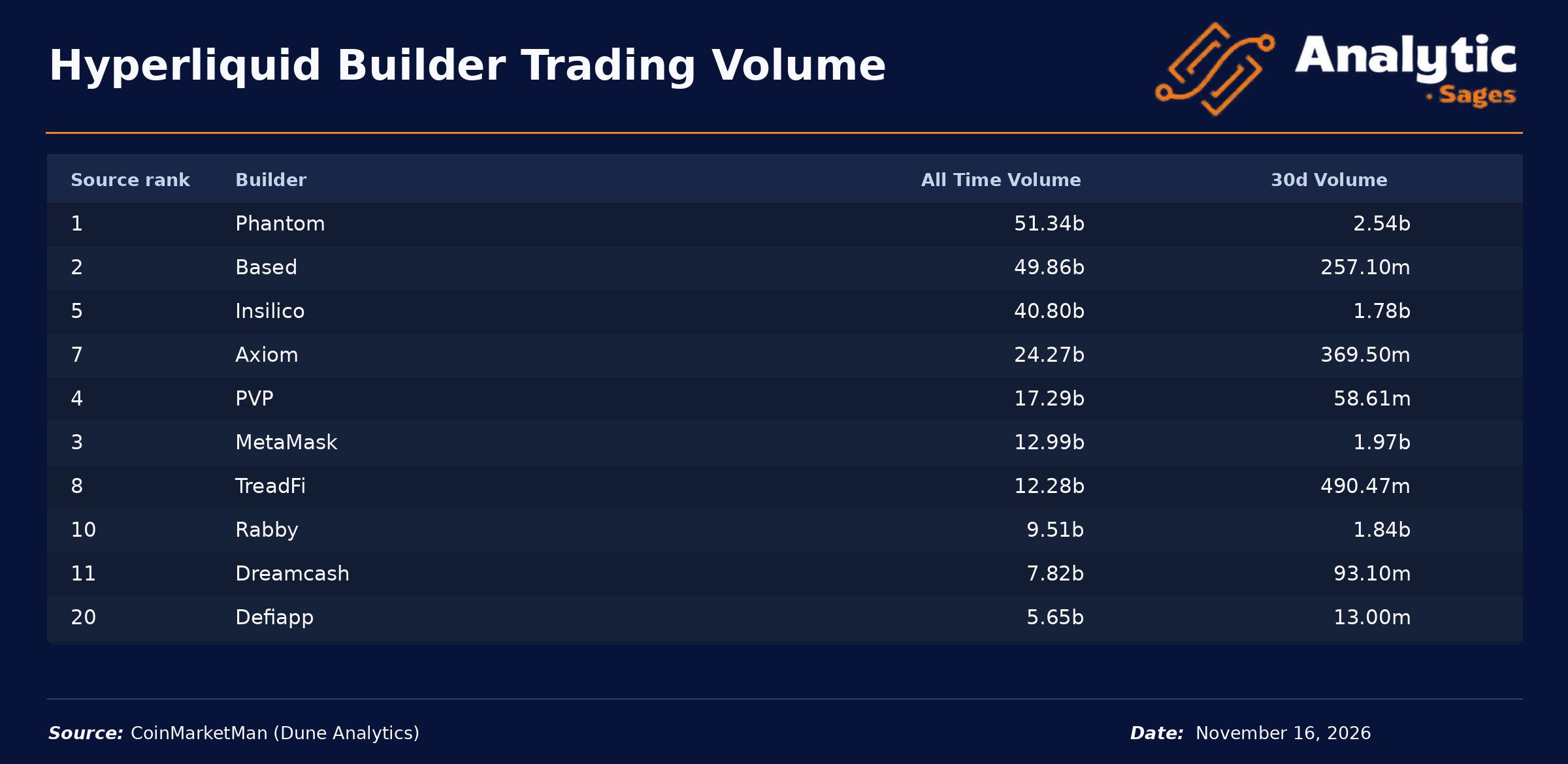
As one of Latin America's largest crypto platforms, serving over 10 million users, Bitso joins apps like Phantom, MetaMask and Rabby that have integrated Hyperliquid into their own interfaces.
And we have already seen how large this distribution model can become.
Phantom alone has routed more than $50 billion in cumulative Hyperliquid trading volume, while MetaMask and Rabby have also generated billions of dollars in activity through their integrations.
Bitso is not starting from zero either.
Its earlier Hyperliquid integration through Onchain.cc had already facilitated roughly $500 million in cumulative perpetual-futures volume, so this latest expansion brings those markets directly into Bitso Alpha, where its more active traders already operate.
The setup is relatively simple: Bitso provides the interface and access to its existing users, while Hyperliquid provides the underlying trading infrastructure and liquidity.
For Hyperliquid, this creates another path to growth.
Rather than depending only on traders coming directly to its own application, the protocol can increasingly reach users through wallets, exchanges and financial platforms they already use.
The bigger question now is whether Bitso can replicate some of the traction we have already seen from integrations like Phantom, this time across one of Latin America's largest crypto user bases.
That is what we will be watching next.
Bitcoin Falls Below $62K: Is Demand Starting to Break?
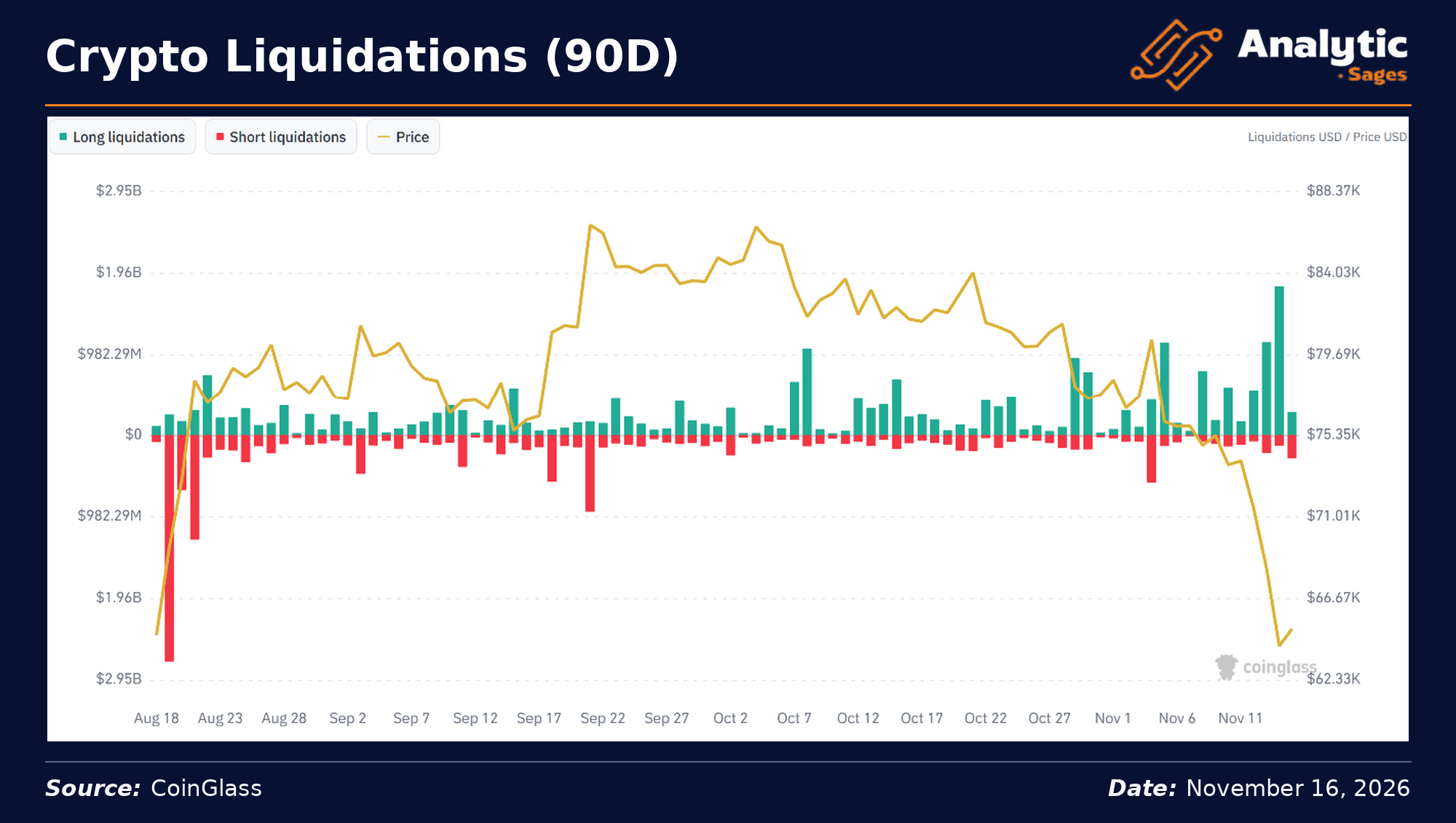
Bitcoin's decline has now extended below $62,000, revisiting levels last seen in July and leaving it roughly 28% below its late-September highs.
Most people point to liquidations as one of the major reasons for the move, and to be fair, it played a big role.
On November 13 alone, about $1.64 billion in crypto positions were liquidated over 24 hours, with longs accounting for nearly 89% of the total.
But liquidations may only explain part of what is happening because there are already several indicators pointing to a slowdown in demand.
For example, CryptoQuant's apparent demand measure has remained negative, while the Coinbase Premium has also stayed below zero, showing that U.S. spot buyers have not been stepping in strongly during the decline. Stablecoin liquidity has also been shrinking, with Glassnode reporting the fastest contraction in supply since June 2022.
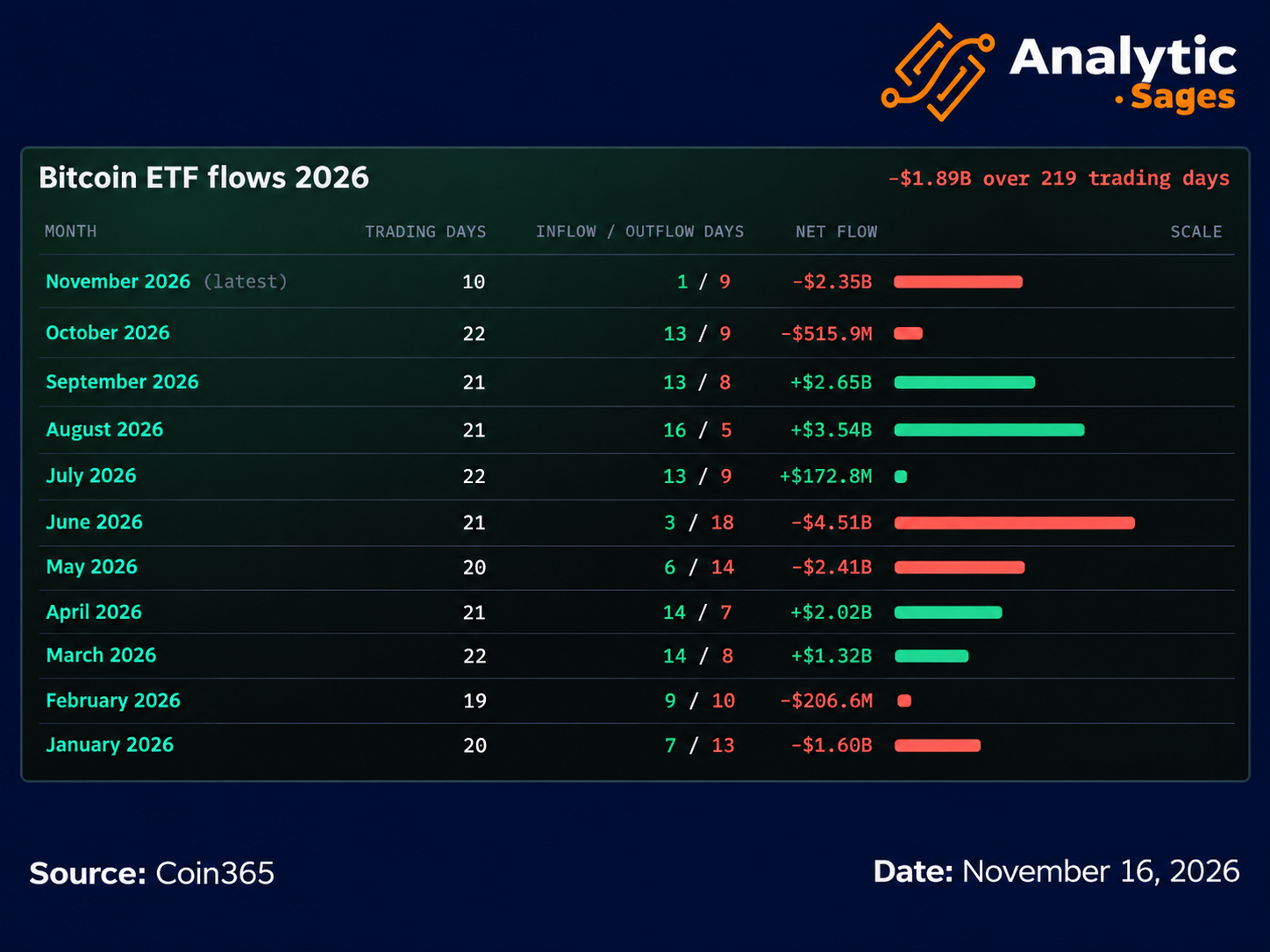
For Bitcoin, ETFs tell a similar story.
U.S. spot Bitcoin ETFs recorded six consecutive days of outflows totalling roughly $1.44 billion by November 13. More broadly, the funds had moved to about $1.56 billion in net outflows for 2026, reversing the strong inflows seen in the previous two years.
The macro environment is also making things harder.
Hotter-than-expected October inflation has increased expectations of another Federal Reserve rate hike in December, strengthening the dollar and pushing bond yields higher, which is generally bad for risk assets like Bitcoin.
There is also another potential problem ahead for Bitcoin.
MSCI will remove Strategy from the MSCI USA and MSCI World indexes from December 1, potentially putting pressure on its shares and making future capital raising more difficult.
This matters because Strategy has relied heavily on equity and debt financing to fund its Bitcoin purchases. If raising capital becomes harder, one of Bitcoin's biggest sources of corporate demand could also weaken.
Until some of these pressures begin to unwind, Bitcoin remains in a weak market.
Disclaimer
This research is provided for informational and educational purposes only and should not be considered financial, investment, legal, tax, or trading advice.
Analytic Sages makes reasonable efforts to ensure that the information, data, and analysis presented are accurate at the time of publication. However, markets, protocols, regulations, and onchain data can change quickly, and third-party information may be incomplete, delayed, or subject to revision.
Any views, interpretations, or conclusions expressed are based on the available data and research methodology at the time of publication and should not be treated as guarantees of future performance or outcomes.
References to tokens, protocols, companies, funds, or financial products do not constitute an endorsement or recommendation to buy, sell, or hold any asset. Readers should conduct their own research and, where appropriate, consult qualified professional advisers before making financial or investment decisions.
Past performance is not indicative of future results
Authors and contributors
Modestus Okoye
Research Lead · Editor
David Abimbola
Research Analyst · Author